
AOCS (Attitude and Orbit Control System) is responsible for determining a satellite’s attitude, controlling its pointing direction, and adjusting its orbit when needed. For CubeSats and small satellites, AOCS directly affects payload pointing accuracy, communication performance, power management, and overall mission capability.
AOCS and ADCS are both common terms in satellite attitude-related systems, but they emphasize different aspects.
- AOCS (Attitude and Orbit Control System) typically covers attitude determination, attitude control, and orbit control functions.
- ADCS (Attitude Determination and Control System) primarily focuses on the measurement, estimation, and control of satellite attitude. It usually includes attitude sensors, attitude determination algorithms, control algorithms, and attitude actuators.
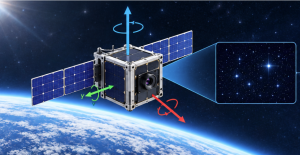
A typical AOCS consists of attitude sensors, attitude determination algorithms, control algorithms, actuators, and an onboard computer. These components work together to form a complete measurement–computation–control closed loop.
Attitude sensors measure the satellite’s orientation relative to a reference frame or provide observation data needed to compute attitude.
Common attitude sensors include:
- Star Tracker: Observes stars and matches them to a star catalog to provide high-accuracy attitude reference. Suitable for missions requiring high pointing precision.
- Sun Sensor: Measures the direction of the Sun relative to the satellite. Commonly used for Sun pointing, initial attitude acquisition, and safe mode.
- Magnetometer: Measures the direction and strength of the Earth’s magnetic field and can be combined with a geomagnetic model for attitude estimation.
- Gyroscope: Measures the satellite’s angular rate. Used to track attitude changes and support dynamic attitude estimation.
These algorithms process sensor data to estimate the satellite’s current three-axis attitude.
Based on the error between the current attitude and the target attitude, these algorithms compute the required control torques and send commands to the actuators.
Actuators change the satellite’s rotational state according to control commands. Common devices include:
- Reaction Wheel: Generates control torque by changing the wheel’s spin rate. Suitable for attitude stabilization and precise pointing.
- Magnetorquer: Produces control torque through interaction between electromagnetic coils (or magnetic materials) and the Earth’s magnetic field. Commonly used on small satellites for attitude control and momentum dumping.
- Thruster: Generates thrust for attitude maneuvers and, when a propulsion system is available, can also be used for orbit adjustments.
The onboard computer runs the AOCS software, processes sensor data, executes attitude determination and control algorithms, and issues commands to the actuators.
Send us a message,we will answer your email shortly!

TY-Space Technology (Beijing) Ltd. is professional focusing on advanced attitude optical sensors, especially Star Trackers for space industry.