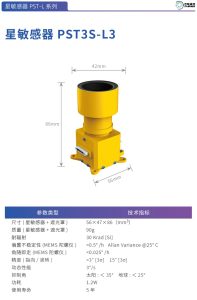

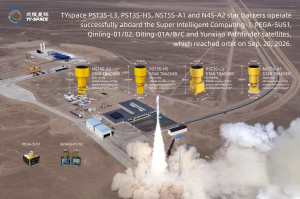
At 12:03 Beijing Time on September 20, 2026, the Kinetica-1 (Lijian-1) Y18 launch vehicle, branded “Chaozhisuan,” lifted off from the Dongfeng Commercial Space Innovation Pilot Zone. In a one-rocket-nine-satellite configuration, it successfully delivered Super Intelligent Computing-1, PEGA-SUS1 (Pengcheng First Satellite / Pengcheng-Nanke-1), Qinling-01/02, Diting-01 A/B/C, and other satellites precisely into their planned orbits. A total of 13 TY-Space star trackers—two PST3S-L3 pico units, six PST3S-H5 pico units, three NST5S-A1 nano units, and two NST4S-A2 nano units—entered orbit with the satellites, and the mission was a complete success.
Super Intelligent Computing-1 is a high-resolution remote-sensing satellite custom-developed under the lead of Chaozhisuan (Beijing) Technology Co., Ltd. It is primarily intended for data applications in smart cities, natural-resource survey and supervision, precision agriculture, ecological and environmental protection, and emergency disaster relief.
PEGA-SUS1 (Pengcheng First Satellite / Pengcheng-Nanke-1) is an integrated communications-sensing-computing technology demonstration satellite jointly developed by GalaxySpace, Pengcheng Laboratory, and the Southern University of Science and Technology. Its main mission is to conduct sequential in-orbit verification of 5G NTN satellite-to-ground communications, onboard AI intelligent computing, and 100 Gbps high-speed satellite-to-ground laser communications.
The Qinling Satellite (01 and 02) project was formally approved by the Shaanxi Provincial Development and Reform Commission in October 2022. As the first pair of satellites in the Qinling Constellation, these high-resolution remote-sensing satellites primarily serve ecological protection of the Qinling Mountains and high-quality regional development, while also constituting a major public-data infrastructure for Shaanxi Province.
Diting-01 A/B/C are commercial electromagnetic-spectrum monitoring satellites overall developed by Tianjin Xingkan Jiuzhou Technology Co., Ltd. They are mainly used for in-orbit technical verification of space-based electromagnetic-spectrum monitoring.
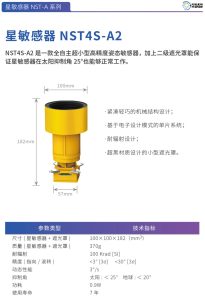
The TY-Space star trackers applied in this mission have been successfully used in multiple satellites and constellation projects, including Dier-5, Tianyan-27, Taijing-3 02, and Changguang satellites.