
CubeSat attitude determination refers to determining a satellite’s three-dimensional orientation in space by measuring and analyzing its direction relative to a reference coordinate frame. It is an essential part of a CubeSat Attitude Determination and Control System (ADCS). It directly affects pointing accuracy, communication performance, and mission execution.
Improve Payload Pointing Accuracy
Earth observation CubeSats need to point cameras or other imaging payloads toward target areas. The accuracy of attitude information affects imaging location, image quality, and observation accuracy.
Ensure Stable Communication Links
Some CubeSats use directional communication antennas that must point toward ground stations or other spacecraft. Accurate attitude information helps satellites maintain the appropriate communication direction and improves link stability.
Support Scientific Experiments and Technology Demonstrations
Space science experiments and technology demonstration missions may require satellites to observe targets in specific directions, measure the space environment, or conduct in-orbit tests. An attitude determination system provides the necessary orientation information, helping satellites operate according to mission requirements.
Provide Feedback for Attitude Control
Attitude determination measures and calculates a satellite’s current orientation. Attitude control uses the difference between the current and target orientations to command actuators, such as reaction wheels and magnetorquers, to adjust the satellite’s direction.
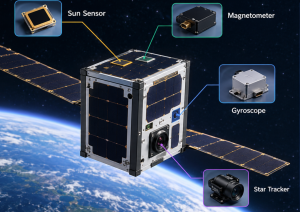
Sun Sensors
Sun sensors measure the direction of the Sun relative to the satellite and provide reference information for attitude determination. Their designs are generally simple, making them suitable for CubeSats with strict mass, volume, and cost constraints.
Magnetometers
Magnetometers measure the direction and strength of the Earth's magnetic field at the satellite's location. By combining magnetic field models with data from other sensors, the system can use magnetic field measurements to estimate the satellite's attitude.
Gyroscopes
Gyroscopes measure a satellite’s angular velocity and help track changes in its attitude over time. They are commonly used for attitude propagation, dynamic motion estimation, and sensor data fusion.
Star Trackers
A Star Tracker is a high-precision attitude sensor that uses stars as references. It is also an important component of many high-precision CubeSat attitude determination solutions.
A star tracker uses an optical system and an image sensor to capture star images. Algorithms then perform star extraction, star pattern recognition, and attitude determination. By matching the observed stars with known stars in a star catalog, the star tracker calculates the satellite’s attitude relative to an inertial reference frame.
Send us a message,we will answer your email shortly!

TY-Space Technology (Beijing) Ltd. is professional focusing on advanced attitude optical sensors, especially Star Trackers for space industry.