ADCS stands for Attitude Determination and Control System. It is a subsystem responsible for determining and controlling a satellite's three-dimensional orientation.
In satellite engineering, attitude refers to the orientation of a spacecraft relative to a reference coordinate frame. It describes the direction in which the satellite's body axes point in space.

Determine Satellite Attitude
The primary function of an ADCS is to determine the satellite's current attitude.
The system collects measurement data from sensors such as star trackers, sun sensors, gyroscopes, and magnetometers. An onboard computer then processes this data to estimate the satellite's current attitude.
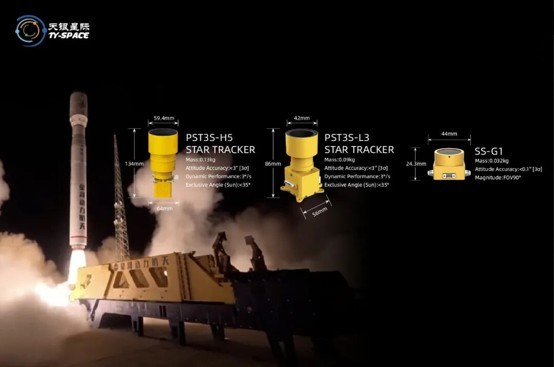
Star trackers are particularly important for high-precision attitude determination. They capture images of stars, identify star points, and match them with an onboard star catalog to calculate the satellite's attitude.
Maintain Stable Satellite Pointing
Satellites often need to maintain their orientation toward a specific target for extended periods.
Control Satellite Rotation
A satellite can rotate around three principal axes:
Correct External Disturbance Torques
Satellites experience various external forces and torques while operating in orbit.
Support Satellite Mission Operations
Different satellite missions have different requirements for attitude control capabilities.
What Is the Role of a Star Tracker in ADCS?
A star tracker is a key attitude sensor in many high-precision satellite ADCS architectures. It determines the satellite's orientation by capturing images of stars and matching their positions with a reference star catalog.
Unlike sensors that rely on Earth's magnetic field or the Sun's direction, star trackers use stars as celestial references to provide high-precision attitude measurements.
The main advantages of star trackers include:
Send us a message,we will answer your email shortly!

TY-Space Technology (Beijing) Ltd. is professional focusing on advanced attitude optical sensors, especially Star Trackers for space industry.