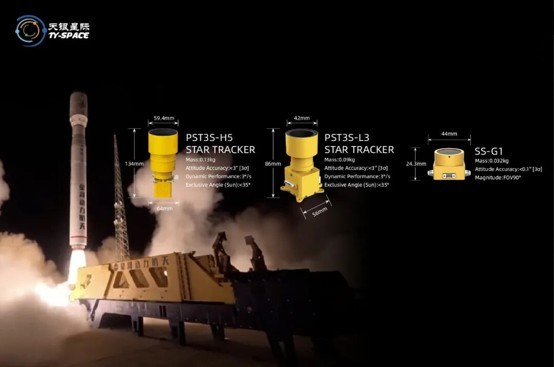
A star tracker is a core navigation sensor in a satellite's Attitude Determination and Control System (ADCS). It captures images of stars, identifies star points, and matches them against an onboard star catalog. It then calculates the satellite's attitude relative to inertial space, providing high-precision attitude measurement data.
What type of star tracker is suitable for different satellite missions? What key factors should satellite manufacturers consider when selecting a Star Tracker for Satellites?
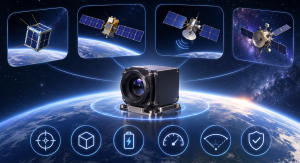
CubeSats and nanosatellites usually face strict limitations on size, weight, and power consumption. Traditional star trackers designed for large satellites may not meet the resource requirements of these platforms.
Therefore, compact design, lightweight construction, and low power consumption are essential features of star trackers for CubeSats.
Earth observation satellites use optical cameras and other imaging payloads to collect information about Earth's surface. Attitude errors can directly affect payload pointing accuracy and image quality.
These satellites generally require star trackers with high measurement accuracy and excellent long-term stability.
Communication satellites need to maintain stable antenna pointing toward ground stations, target areas, or other spacecraft.
For high-throughput communication satellites and laser communication satellites, attitude measurement errors can affect communication link acquisition and stability.
Therefore, reliability and stable attitude measurement are essential selection criteria.
Scientific satellites perform missions such as space observation, astronomical research, and space environment monitoring.
These satellites may need to maintain specific observation directions for extended periods. As a result, they require high attitude measurement accuracy and long-term stability.
Attitude accuracy is one of the most important indicators of star tracker performance. It is typically expressed in arcseconds (arcsec) or arcminutes (arcmin).
However, the measurement accuracy of a star tracker is not the same as the overall pointing accuracy of a satellite. System-level pointing performance is also affected by gyroscopes, control algorithms, actuators, structural deformation, and installation errors.
For CubeSats and nanosatellites, the size and weight of a star tracker directly affect spacecraft structural design and payload configuration.
Compact star trackers help satellite manufacturers save installation space and mass resources. They also leave more room for other payloads and onboard equipment.
Star trackers typically operate continuously to provide attitude data to the satellite's ADCS.
Low-power design is particularly important for small satellites with limited solar panel area and power budgets.
The update rate determines how frequently a star tracker outputs attitude information.
For satellites with rapid attitude changes or demanding response requirements, a higher update rate helps the ADCS obtain timely attitude information and respond more effectively.
The field of view (FOV) refers to the angular region of the sky that a star tracker can observe.
A wider FOV generally increases the opportunities for star acquisition and identification. However, optical system design, star distribution, and stray light suppression must also be considered.
Once a satellite is launched, repairing or replacing its star tracker is usually difficult.
Therefore, star trackers must undergo rigorous environmental testing and reliability verification before launch. These processes help ensure reliable performance under demanding space conditions.
Send us a message,we will answer your email shortly!

TY-Space Technology (Beijing) Ltd. is professional focusing on advanced attitude optical sensors, especially Star Trackers for space industry.