
Star Trackers are one of the most important high-precision attitude measurement devices used in modern spacecraft. By capturing star images and matching the identified star points with an onboard star catalog, a star tracker calculates the spacecraft’s three-axis attitude and provides high-precision attitude data for the spacecraft Attitude Determination and Control System (ADCS).
Different orbital environments place different performance requirements on star trackers. Low Earth Orbit (LEO) satellites and Geostationary Orbit (GEO) satellites differ significantly in terms of orbital altitude, mission type, operational cycle, and attitude control requirements. Therefore, the design priorities of their star trackers are also different.
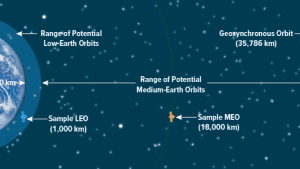
LEO satellites typically operate at altitudes between 160 and 2,000 km and are widely used for Earth observation, remote sensing, satellite communication constellations, and scientific experiments. Due to their high orbital velocity, LEO satellites frequently pass over different regions of the Earth and often require rapid attitude adjustments to perform target acquisition, imaging, and communication tasks.
Therefore, LEO star trackers focus more on fast attitude updates, high dynamic response capability, and miniaturized design. In addition, because the Earth occupies a large portion of the field of view in low Earth orbit, star trackers are more likely to be affected by stray light sources such as direct sunlight, reflected Earth light, and atmospheric glow. As a result, LEO star trackers require advanced optical shielding and strong stray light suppression capabilities.
GEO satellites operate at an altitude of approximately 35,786 km and are mainly used for communication, broadcasting, meteorological observation, and space data relay missions. These satellites are typically required to operate reliably for long periods while maintaining precise pointing of antennas or payloads toward target regions.
Compared with LEO satellites, GEO satellites have much higher requirements for attitude accuracy and system reliability. Even small attitude errors can cause communication antennas to deviate from their target areas, reducing signal quality and system efficiency. Therefore, GEO star trackers focus on arcsecond-level or even sub-arcsecond measurement accuracy, long-term stability, thermal environment adaptability, and radiation resistance.
LEO star trackers focus more on fast response, compact size, low power consumption, and adaptability to complex lighting environments. They are suitable for dynamic missions such as CubeSats, small satellites, and Earth observation satellites.
GEO star trackers focus more on extremely high accuracy, long-term operational stability, and high reliability. They are widely used in communication satellites, navigation satellites, and large spacecraft.
Send us a message,we will answer your email shortly!

TY-Space Technology (Beijing) Ltd. is professional focusing on advanced attitude optical sensors, especially Star Trackers for space industry.