

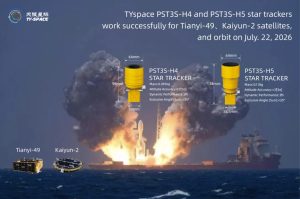
At 10:54 Beijing Time on July 22, 2026, in the eastern sea area of Shanghai, the Gravity-1 Y4 launch vehicle, the world's largest solid-propellant rocket, soared into the sky and successfully launched the Tianyi-49 satellite and Kaiyun-2 satellite. One TY-SPACE PST3S-H4 star tracker and two TY-SPACE PST3S-H5 star trackers smoothly entered the designated orbit along with the satellites, and the mission was completed successfully.
As a 50-kilogram-class space science experimental satellite, the Tianyi-49 carries a small remote sensing camera and will conduct a series of Earth observation technology verification tests after orbit insertion.
The Kaiyun-2 University Satellite Alliance satellite adopts an innovative dish-shaped configuration and is equipped with high-performance star trackers. It efficiently performs on-orbit attitude measurement and star map identification, ensuring stable satellite operation and platform technology verification. The space object data collected by the satellite provides solid data support and a scientific decision-making basis for spacecraft on-orbit safety management, space collision risk warning, and large-scale constellation networking planning.
The TY-SPACE PST3S-H4 and PST3S-H5 star trackers have been successfully applied in multiple satellite and satellite constellation projects, including the Honghu satellite, Tianyi-33 satellite, and Kaiyun-1 satellite.
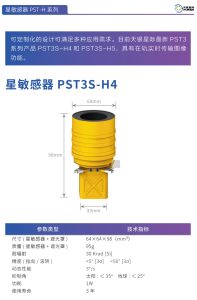
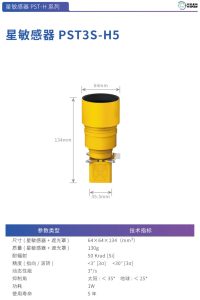
TY-Space Technology (Beijing) Ltd. is professional focusing on advanced attitude optical sensors, especially Star Trackers for space industry. TY-Space Star Trackers successfully launched and operating flawlessly on board of High Resolution Remote Sensing Project, Lunar Exploration Program and other satellites & on-orbit applications.