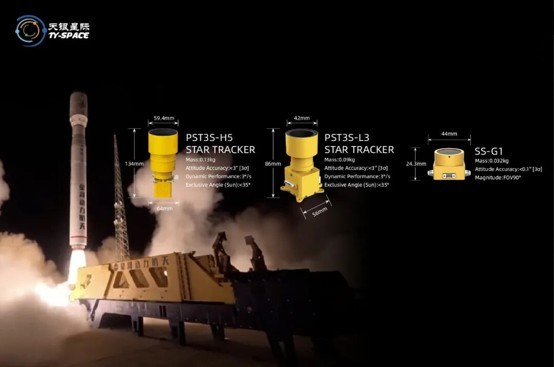
Star sensors are essential components of modern satellite Attitude Determination and Control Systems (ADCS). They provide high-precision attitude measurement data for satellites operating in different orbital environments.
In many satellite applications, star sensors are also known as Star Trackers. Both terms generally refer to optical devices that determine spacecraft attitude by observing stars.
Star sensors can be classified into different types based on their optical configurations, performance specifications, and application requirements.
Pico Star Sensors
Pico star sensors are primarily designed for small satellites and CubeSats. They feature compact structures, low power consumption, and lightweight designs. These characteristics make them suitable for satellite missions with strict mass, volume, and power constraints.
Nano Star Sensors
Nano star sensors provide attitude measurement capabilities for nanosatellites. They balance measurement accuracy, size, weight, and power consumption. They are widely used in commercial small satellite platforms.
High-Accuracy Star Sensors
High-accuracy star sensors are designed for space missions with demanding attitude determination requirements. These products offer high measurement accuracy and stability. Typical applications include Earth observation, scientific research, and precision pointing missions.
Star sensors are widely used in different types of space missions.
Earth Observation Satellites
Earth observation satellites require accurate attitude information to maintain their imaging direction and improve image quality. Star sensors provide essential attitude references for stable Earth observation operations.
Communication Satellites
Communication satellites require accurate attitude information to maintain antenna pointing directions. Star sensors help satellites maintain stable communication links and precise spacecraft orientation.
Scientific Satellites
Scientific missions often require spacecraft to point accurately toward specific celestial objects or observation targets. Star sensors provide reliable attitude measurement data for these operations.
CubeSats and Small Satellites
CubeSats and small satellites typically have limited onboard resources. Compact star sensors provide high-precision attitude information while meeting strict size, weight, and power requirements.
Remote Sensing Constellations
Large satellite constellations require multiple spacecraft to maintain consistent attitude performance. Star sensors help maintain stable pointing accuracy and support coordinated mission operations.
Send us a message,we will answer your email shortly!

TY-Space Technology (Beijing) Ltd. is professional focusing on advanced attitude optical sensors, especially Star Trackers for space industry.