
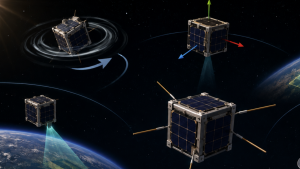
ADCS (Attitude Determination and Control System) is one of the key subsystems in CubeSats and small satellites. It determines the spacecraft’s attitude and controls its orientation to meet mission requirements such as stabilization, payload pointing, communication, and autonomous maneuvering.
What Is the Role of ADCS in CubeSats?
Satellite Detumbling
After a CubeSat separates from the launch vehicle, it may have a relatively high angular velocity. ADCS must reduce the satellite’s rotation rate and bring it into a normal operating state.
Attitude Stabilization
After detumbling, ADCS maintains a stable spacecraft attitude. Stable attitude is important for the following missions: Depending on mission requirements, CubeSats can use simple passive stabilization systems or active three-axis stabilization systems. More demanding missions typically combine reaction wheels, magnetorquers, gyroscopes, and optical attitude sensors.
High-Precision Payload Pointing
High-precision ADCS enables CubeSats to perform missions that previously typically required larger spacecraft.
Earth Observation
ADCS plays an important role in CubeSat Earth observation missions. The satellite must control its attitude so that the imaging payload points toward the target area. Precise attitude control can improve: image quality, ground target positioning, imaging repeatability, and data acquisition efficiency. Modern small satellite ADCS systems increasingly integrate star trackers, reaction wheels, gyroscopes, and control software to support high-precision imaging missions.
Communication Pointing
CubeSats are increasingly using directional communication antennas and high-speed communication links. Pointing accuracy is particularly important for missions that use highly directional communication links.
Sun Tracking
CubeSats rely heavily on solar power. ADCS can control the spacecraft’s attitude to maintain an appropriate relative orientation between the solar panels and the Sun.
Autonomous Satellite Operations
Modern CubeSats increasingly rely on autonomous operation.ADCS can automatically perform: determining spacecraft attitude, detecting attitude errors, executing attitude maneuvers, maintaining target pointing, and recovering from certain abnormal conditions.
Send us a message,we will answer your email shortly!

TY-Space Technology (Beijing) Ltd. is professional focusing on advanced attitude optical sensors, especially Star Trackers for space industry.