
Nano satellites are often subject to strict limitations in size, weight, power consumption, and cost. At the same time, they still require precise attitude control. Star trackers can provide high-accuracy attitude information for these applications.
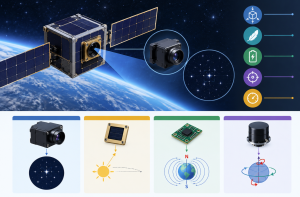
Compact Size
The internal space of nano satellites is limited. Star trackers need to adopt a compact mechanical design. Smaller sensors can simplify the satellite's internal layout and leave more space for payloads and other subsystems.
Low Mass
Every gram of mass is important for a nano satellite. A lightweight star tracker can help reduce the overall spacecraft mass. This is particularly valuable for missions with strict mass constraints.
Low Power Consumption
Nano satellites are often limited by their power generation and energy storage capabilities. Star trackers need to operate efficiently to avoid placing excessive demands on the spacecraft's power system.
High Attitude Accuracy
Accuracy is one of the most important parameters of a star tracker. The required accuracy depends on the specific mission. Earth observation, scientific instruments, and high-resolution imaging missions may require higher attitude accuracy than some technology demonstration missions.
Fast Attitude Determination
Nano satellites may experience attitude changes during on-orbit operations. Star trackers need to process star images efficiently and output attitude information within an appropriate time.
Differences Between Star Trackers and Other Attitude Sensors
Nano satellites can use different types of attitude sensors depending on mission requirements.
Sun sensors have a relatively simple structure and can determine the direction of the Sun. However, they cannot provide the same type of celestial reference as star trackers.
Magnetometers determine attitude by measuring the Earth's magnetic field. Their performance may be affected by magnetic interference generated by the spacecraft itself.
Gyroscopes measure angular velocity rather than directly providing an absolute attitude reference. Their errors can accumulate over time.
Send us a message,we will answer your email shortly!

TY-Space Technology (Beijing) Ltd. is professional focusing on advanced attitude optical sensors, especially Star Trackers for space industry.