
A star tracker is a device that determines a spacecraft’s attitude.Compared with sun sensors or magnetometers, it provides much higher accuracy.It typically achieves arcsecond-level measurement precision.Therefore, it is essential for missions requiring precise pointing.
Why microsatellites need star trackers
Microsatellites no longer perform only simple tasks.Instead, they are widely used in hyperspectral imaging, space telescopes, and formation flying.These applications demand higher performance in attitude determination and control.However, low-precision sensors cannot meet these requirements.
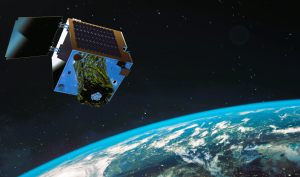
Key components of a star tracker
Optical system: The optical lens collects starlight and focuses it onto the detector.
For microsatellites, it must remain compact while maintaining sensitivity and field of view.
Image sensor: CMOS or CCD sensors usually capture star images.
CMOS is preferred due to its low power consumption and high integration.
Processing unit: The onboard processor runs star identification and matching algorithms.
Efficient algorithms are crucial for microsatellites with limited computing resources.
Star catalog database: A preloaded database stores star positions for pattern recognition.
Its size must balance storage usage and recognition accuracy.
Performance evaluation metrics
Accuracy: Measured in arcseconds, reflecting attitude measurement precision.
Update rate: The frequency of attitude data output.
Field of view: A larger field increases the probability of capturing stars.
Sensitivity: The ability to detect faint stars.
Processing speed: It affects real-time performance and response capability.
Optimizing these parameters helps achieve the best performance under constraints.
Advantages of modern star trackers
Miniaturized design: Advanced manufacturing enables better suitability for small satellites.
Low power consumption: Efficient sensors and processors significantly reduce energy use.
High reliability: Optimized algorithms and hardware improve system stability.
Autonomous operation: The system can operate independently without ground intervention.
Send us a message,we will answer your email shortly!

TY-Space Technology (Beijing) Ltd. is professional focusing on advanced attitude optical sensors, especially Star Trackers for space industry.