
A high precision ADCS is a subsystem designed to determine and control spacecraft attitude with high accuracy and stability. The system continuously measures spacecraft attitude and compares the measured attitude with the target attitude. The control system calculates the required corrections and sends commands to the actuators.
Spacecraft pointing accuracy directly affects mission performance. For Earth observation satellites, even small attitude errors can affect image quality and target positioning. Communication satellites also require stable pointing. Their antennas must maintain the correct orientation to continuously point toward ground stations or other spacecraft. Scientific spacecraft may have even more demanding requirements. Telescopes and other scientific instruments may require extremely stable pointing to obtain reliable scientific data.
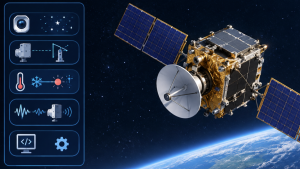
Sensor Accuracy: The performance of attitude sensors directly affects attitude determination. Star tracker accuracy, gyroscope performance, sensor noise, and calibration can all affect overall performance.
Sensor Alignment Errors: Even highly accurate sensors can produce errors if their installation position and orientation are not properly calibrated.
Thermal Stability: Temperature changes can cause mechanical deformation and affect optical and electronic performance. Therefore, thermal design and calibration are important for high precision spacecraft systems.
Structural Disturbances: Spacecraft vibrations can affect sensor and actuator performance. Reaction wheel imbalance, moving mechanisms, and other onboard equipment can introduce disturbances.
Control Algorithms: ADCS software determines how sensor data is processed and how control commands are generated. Accurate attitude estimation and well-designed control algorithms are important for achieving the required pointing performance.
Earth Observation Satellites: Earth observation spacecraft typically require precise pointing toward target areas.
Communication Satellites: Communication spacecraft need to maintain high-precision antenna pointing.
Scientific Satellites: Scientific missions may require highly stable spacecraft attitude.
CubeSats: Small satellites are often subject to strict limitations on space, mass, power consumption, and cost.
Deep-Space Spacecraft: Deep-space missions typically require long-term autonomous attitude control.
Send us a message,we will answer your email shortly!

TY-Space Technology (Beijing) Ltd. is professional focusing on advanced attitude optical sensors, especially Star Trackers for space industry.