
When selecting an ADCS (Attitude Determination and Control System), mission requirements, orbital environment, payload requirements, and system resources should all be considered.
Pointing Accuracy
Pointing accuracy is one of the most important factors when selecting an ADCS. Different missions have different pointing accuracy requirements. For example, communication satellites need to accurately point toward ground stations or communication targets, while high-resolution remote sensing satellites usually require higher pointing accuracy and stability.
Mission Orbit
In low Earth orbit (LEO) missions, magnetorquers can use the Earth’s magnetic field for attitude control and momentum unloading. In contrast, lunar orbit, deep-space, and heliocentric orbit missions cannot rely on the Earth’s magnetic field. Therefore, different ADCS solutions are required.
Payload Requirements
The payload usually determines the attitude performance that the satellite needs to achieve. Remote sensing cameras need to point steadily toward ground targets. Communication payloads need to maintain antenna pointing. Scientific instruments may need to maintain a specific attitude for extended periods.
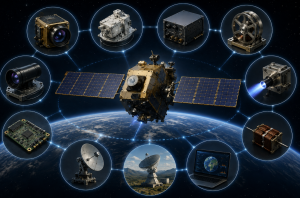
Sensors are responsible for determining the satellite’s current attitude and attitude rate. Different sensors have different levels of accuracy, update rates, power consumption, and environmental adaptability. Star trackers can provide high-precision absolute attitude information. Gyroscopes can quickly measure angular velocity and provide attitude propagation between star tracker updates.
Actuators
Actuators are responsible for changing the satellite’s attitude. Reaction wheels are suitable for high-precision three-axis attitude control. Magnetorquers can be used for attitude control and reaction wheel momentum unloading. Thrusters are suitable for missions requiring large attitude maneuvers or orbital maneuvers.
Size, Weight, and Power
For CubeSats and small satellites, SWaP (Size, Weight, and Power) is a key limiting factor.
Reliability and Redundancy
ADCS is generally a mission-critical system. Any failure in sensors, actuators, or control algorithms may affect the satellite mission.
For long-duration or high-value missions, appropriate redundancy can improve overall mission reliability.
Environmental Adaptability
ADCS must be able to withstand the space environment encountered during satellite operations.
Calibration and Alignment
Installation errors in sensors and actuators can affect the final attitude performance. In particular, angular alignment errors between the star tracker, gyroscope, and payload can directly affect payload pointing accuracy.
Control Algorithms and Software
Hardware performance alone cannot fully determine the final performance of an ADCS. Control algorithms are equally important. Different attitude determination and control algorithms need to be switched according to different mission phases. Studies show that hybrid control and estimation algorithms can help small satellites achieve the required performance with limited hardware resources.
Send us a message,we will answer your email shortly!

TY-Space Technology (Beijing) Ltd. is professional focusing on advanced attitude optical sensors, especially Star Trackers for space industry.