
Star trackers require controlled conditions to verify their performance. Engineers usually compare two testing methods: star simulator testing and real sky testing. Both methods play important roles in spacecraft development, calibration, and verification.
What Is a Star Simulator?
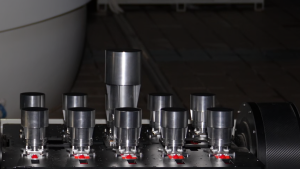
A star simulator is an optical testing device. It generates artificial star patterns inside a laboratory environment. Engineers use it to evaluate and calibrate star trackers without relying on real night skies.
The simulator projects synthetic star fields that imitate actual celestial scenes. In addition, engineers can reproduce different star magnitudes, star positions, spacecraft motion states, and environmental conditions.
What Is Real Sky Testing?
Real sky testing uses actual stars as reference sources. During the test, engineers point the star tracker toward the night sky. The sensor then observes real star fields directly.
This method provides an authentic optical environment. Laboratory systems cannot fully duplicate such conditions. However, real sky testing strongly depends on weather, atmospheric conditions, and geographic location.
Environmental Control
One major advantage of a star simulator is environmental control. Inside a laboratory, engineers can precisely adjust:
In contrast, real sky testing faces many uncontrollable external factors. These factors include cloud cover and urban light pollution.
Repeatability
A star simulator can repeatedly generate the exact same star field. Therefore, engineers can repeat the same test many times while changing only one variable.
Real sky testing cannot guarantee identical conditions every night. Earth’s rotation, seasonal changes, and atmospheric disturbances continuously affect star positions and observation conditions.
Realism
Modern star simulators have become highly advanced. However, they still provide only an approximation of the real environment.
A star tracker may perform well in a laboratory. Yet it can still experience identification errors under real skies. Atmospheric turbulence and stray light often create additional challenges.
For this reason, real sky testing remains an essential final verification step.
Dynamic Motion Simulation
Spacecraft usually rotate during on-orbit operations. Therefore, star trackers must accurately handle angular velocity.
Advanced star simulators can generate:
These capabilities allow engineers to fully verify attitude algorithms.
Real sky testing makes controlled spacecraft motion simulation much harder. Engineers often need additional motion platforms. As a result, the overall system becomes more complex.
Send us a message,we will answer your email shortly!

TY-Space Technology (Beijing) Ltd. is professional focusing on advanced attitude optical sensors, especially Star Trackers for space industry.