
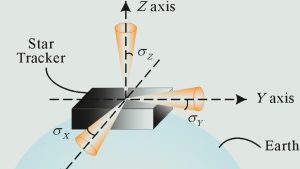
A star tracker is a high-precision optical attitude sensor that determines a spacecraft's orientation by capturing images of the star field and matching them with stars stored in an onboard star catalog. Star tracker data processing refers to the complete computational workflow, from image acquisition to the final attitude output. It mainly consists of the following steps.
Step 1: Image Acquisition
The entire data processing workflow begins with the image sensor capturing the star field. Most modern star trackers use CMOS image sensors, which offer lower power consumption and higher sensitivity than traditional CCD sensors.
Step 2: Image Preprocessing
The raw image contains not only stars but also various types of noise and interference. Therefore, the system first preprocesses the image before identifying any stars.
Step 3: Star Detection
Next, the processor determines which bright spots are actual stars. This process is known as star extraction.
The processor scans the entire image and searches for regions whose brightness exceeds a predefined threshold.
Step 4: Star Centroid Calculation
To achieve higher accuracy, the processor calculates the geometric center of each star image, which is known as the centroid.
Step 5: Star Identification
After detecting the stars, the processor matches the observed star pattern in the current image with the stars stored in the onboard star catalog.
Step 6: Attitude Determination
Once star identification is complete, the processor calculates the spacecraft's attitude.
Step 7: Data Validation
Finally, the star tracker validates the attitude determination results before generating the final output.
Challenges in Star Tracker Data Processing
Star tracker data processing faces several technical challenges.
Low-light environments can introduce significant image noise.
Cosmic rays may produce bright spots that appear brighter than actual stars.
During high-speed spacecraft rotation, stars may form streaks instead of point images.
In addition, sunlight reflected from the spacecraft or other external surfaces may enter the optical system and create stray light.
Furthermore, long-term exposure to the space radiation environment can gradually degrade the image sensor and affect its performance.
Send us a message,we will answer your email shortly!

TY-Space Technology (Beijing) Ltd. is professional focusing on advanced attitude optical sensors, especially Star Trackers for space industry.