
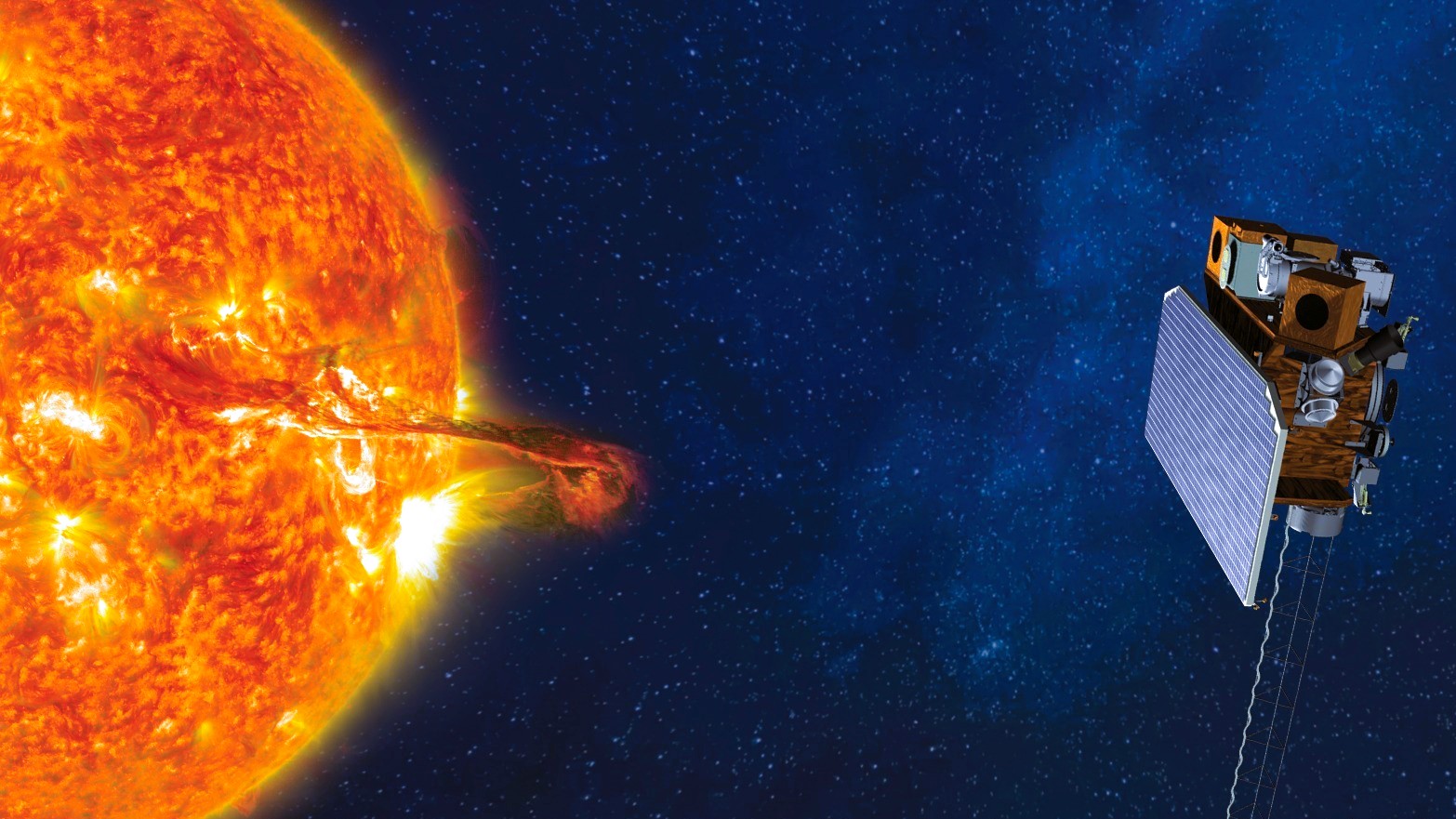
Sun sensors are one of the most critical attitude sensors on satellites, spacecraft, and even some high-altitude stratospheric platforms. They accurately measure the direction of the Sun relative to the spacecraft body. Thus, they provide the attitude determination and control system (ADCS) with essential Sun vector information.
During on-orbit operation, satellites must constantly know their attitude (orientation). Only then can they point solar panels toward the Sun, align communication antennas with Earth, or direct scientific payloads at specific targets.

Classification of Satellite Sun Sensor
Based on different working principles and applications, satellite sun sensors mainly fall into the following categories:
Analog sun sensors (0-D, cosine type)
Digital sun sensors (1-D, position-sensitive type)
Fine sun sensors (2-D, imaging type)
Sun presence sensors (detect only presence/absence)
Analog Sun Sensor
Engineers typically mount 4–6 solar cells or photodiodes on different faces of a pyramid or place them behind slits. Each photodiode has a specific field of view.
When sunlight strikes a photodiode, it generates photocurrent proportional to the cosine of the incidence angle (cos θ). Therefore, engineers compare the currents from multiple photodiodes and derive the approximate Sun direction.
Digital Sun Sensor
These sensors usually employ a linear CCD or PSD (position-sensitive detector) placed behind a slit mask. Sunlight passes through the slit and forms a light stripe on the photosensitive surface.
According to the pinhole imaging principle (or single-slit diffraction approximation), the spot position on the array corresponds linearly to the Sun’s incidence angle.
Fine Sun Sensors (2-D Imaging Type, FSS)
These consist of a precisely machined multi-slit or pinhole mask plus a 2-D image sensor (CMOS APS or CCD) beneath it. The most classic designs use “N-type” or “V-type” slit combinations.
Sunlight passes through the mask and creates multiple parallel light stripes or spot arrays on the image sensor. Then, the system recognizes the relative positions and spacing of these stripes. Consequently, it simultaneously calculates the Sun’s incidence angle in both azimuth and elevation.
Sun Presence Sensors (SPS)
This is the simplest type. It only detects whether the Sun is within the field of view and outputs a digital switch signal (0/1). Engineers commonly use it to trigger solar array drive mechanisms or initiate attitude acquisition after spacecraft separation.
Send us a message,we will answer your email shortly!

TY-Space Technology (Beijing) Ltd. is professional focusing on advanced attitude optical sensors, especially Star Trackers for space industry.