
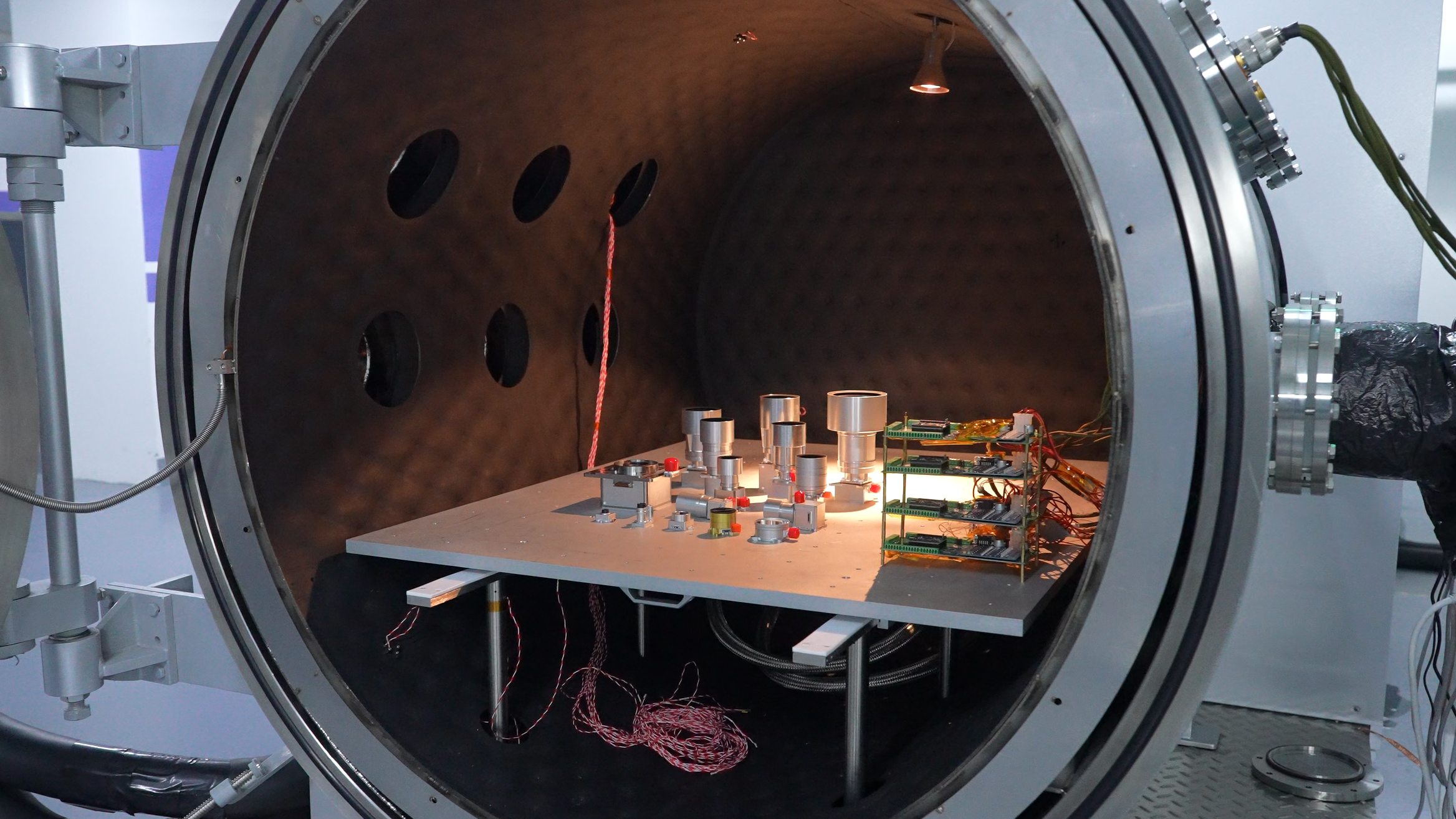
Thermal vacuum testing simulates space environment on the ground. Space features extreme conditions: high temperatures under direct sunlight, low temperatures in shadow, and near-zero air pressure. Engineers design TVAC chambers to create these conditions. They evaluate hardware performance under stress.
The main goal identifies potential design flaws, manufacturing defects, or material weaknesses before launch. Engineers place prototypes or final assemblies in simulated environments. They verify reliability, functionality, and durability.
A thermal vacuum chamber is a sealed container. It usually has a cylindrical or rectangular shape. Builders use sturdy materials like stainless steel. The chamber withstands internal pressures as low as 10⁻⁶ Torr—only a tiny fraction of Earth’s atmospheric pressure.
The testing process starts with high-power vacuum pumps. They remove air from the chamber. Gradually, they create a space-like vacuum. Temperature control uses heatable or coolable shroud panels or heating plates. Liquid nitrogen or gaseous nitrogen provides cooling. Infrared lamps or electric heaters raise temperatures.
Instrumentation monitoring plays a key role. Sensors record temperature, pressure, and performance data in real time. Technicians fix the test object, such as satellite components, inside the chamber. They connect it to power and data lines through interfaces. Tests may last days or weeks. Engineers design cycles to exceed expected mission duration. This accelerates aging and exposes issues.
Space environment shows no mercy—a tiny failure can doom billion-dollar missions. Thermal vacuum testing bridges the gap between theoretical design and real-world application. It helps hardware meet certification standards from agencies like NASA or the European Space Agency (ESA).
Thermal vacuum testing links closely to space. However, its uses extend far beyond. ,engineers test aircraft components for high-altitude flights—where conditions approach vacuum. In military fields, they verify drone or missile performance under extreme conditions.
In the electronics industry, TVAC checks semiconductor reliability for satellites or high-altitude balloons. Even in research, such as studying exoplanet atmospheres or materials science, these chambers provide controlled environments for experiments.
Emerging applications include testing next-generation electric propulsion systems. Ion thrusters must operate in vacuum without overheating. As space tourism rises, manned systems like spacesuits undergo TVAC to simulate extravehicular activities.
Send us a message,we will answer your email shortly!

TY-Space Technology (Beijing) Ltd. is professional focusing on advanced attitude optical sensors, especially Star Trackers for space industry.