
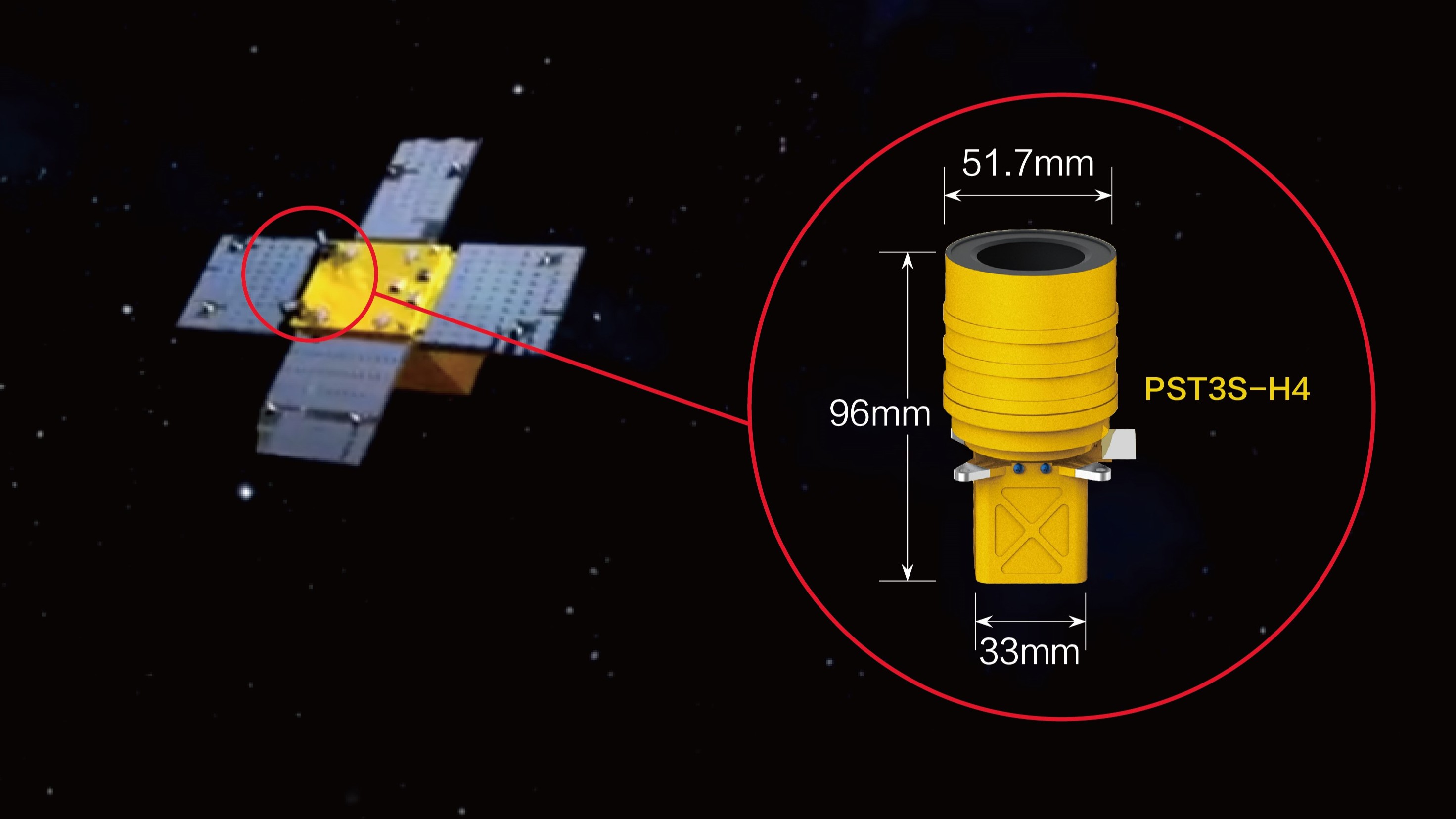
In space, spacecraft maintain their orientation and trajectory. A key device for this is the star tracker, a sophisticated optical instrument serving as the “eyes” of satellites and probes. So, what exactly is a star tracker? Simply put, it’s an optical sensor that observes and identifies star patterns in the sky to determine a spacecraft’s orientation or direction.
A star tracker functions like a high-tech camera pointed at the stars. Its optical lens and sensitive detector, such as a CMOS or CCD sensor, capture images of the celestial sphere. These sensors detect light from stars, convert it into digital data, and send it to an onboard computer for analysis.
The core process involves star pattern recognition. The star tracker compares observed star positions with a preloaded star catalog, containing thousands of stars’ coordinates, brightness, and spectral characteristics, using advanced algorithms based on computer vision-like pattern matching to identify matches and determine the spacecraft’s precise orientation in three-dimensional space, including roll, pitch, and yaw.
Here’s a step-by-step breakdown of the process:
Image Acquisition: The star tracker captures sky snapshots at fixed intervals, typically every few seconds, depending on mission needs.
Centroiding: Software identifies the centers (centroids) of bright spots (stars) in the image, filtering out noise from cosmic rays or stray light.
Pattern Matching: Geometric algorithms match these centroids to known star patterns, such as the Big Dipper or Orion, as reference points.
Attitude Calculation: Once matched, the system calculates quaternions or Euler angles representing the spacecraft’s orientation relative to an inertial reference frame.
Output and Integration: The data feeds into the spacecraft’s attitude control system (ACS), which adjusts thrusters or reaction wheels to maintain the desired direction.
Star trackers achieve remarkable precision, often accurate to arcseconds—equivalent to spotting a coin from miles away. They operate autonomously, making them ideal for long-duration missions with intermittent ground communication. However, they must handle challenges like intense sunlight interference, which baffles and sunshades help mitigate.
Optical Components: Lenses and mirrors focus starlight onto the sensor, with high-quality optics ensuring minimal distortion.
Detector Array: Modern systems use active pixel sensors (APS) for enhanced radiation resistance in space environments.
Processing Unit: Embedded computers run algorithms, with advances in field-programmable gate array (FPGA) technology boosting computation speed.
Star Catalog: Stored in memory, it may include up to 10,000 stars, selected based on visibility and sky distribution.
Baffles and Shields: These block unwanted light sources, ensuring only starlight is captured.
Send us a message,we will answer your email shortly!

TY-Space Technology (Beijing) Ltd. is professional focusing on advanced attitude optical sensors, especially Star Trackers for space industry.