

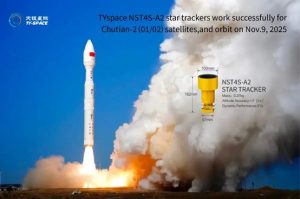
“At 11:32 AM Beijing time on November 9, 2025, two technology demonstration satellites of the Chutian constellation were launched into space by the Lijiang-1 Y9 carrier rocket from the Jiuquan Satellite Launch Center. After entering orbit, all telemetry parameters were normal, and the satellites were in good condition. The launch mission was a complete success. The satellites use four TY-Space NST4S-A2 nano-star trackers.”
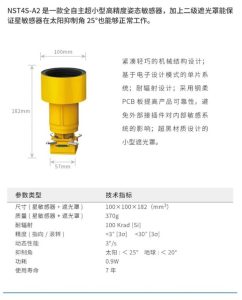
NST4S-A2 Star Tracker
Satellite Introduction
The two technology demonstration satellites launched and placed into orbit this time are primarily used to conduct optical remote sensing Earth observation experiments. After entering orbit, they will verify the satellites’ Earth observation capabilities and super-resolution processing application capabilities. The satellites will mainly be applied in areas such as the safe operation and maintenance of large-scale water conservancy facilities, dynamic monitoring of the marine ecological environment, and natural disaster prediction, early warning, and disaster assessment, thus helping to further enhance China’s disaster prevention, mitigation, relief, and emergency management capabilities.

TY-Space Technology (Beijing) Ltd. conforms to the development trend of the “star era” of commercial aerospace and has taken the lead in realizing the mass production of star trackers in China. Board-level screening, electronics testing, whole-machine thermal cycling, thermal vacuum vibration, and field stargazing have all been completed in batches automatically. All test reports and test results are automatically output, the remote monitoring process is clear and more efficient, and the annual output can reach 2,000 sets, which can meet the satellite factory’s mass production requirements for high-performance, high-reliability, high-output, and high-delivery-speed star tracker products. Up to now, more than 1,000 TY-Space Technology (Beijing) Ltd. interstellar star tracker products have been successfully operated in orbit!