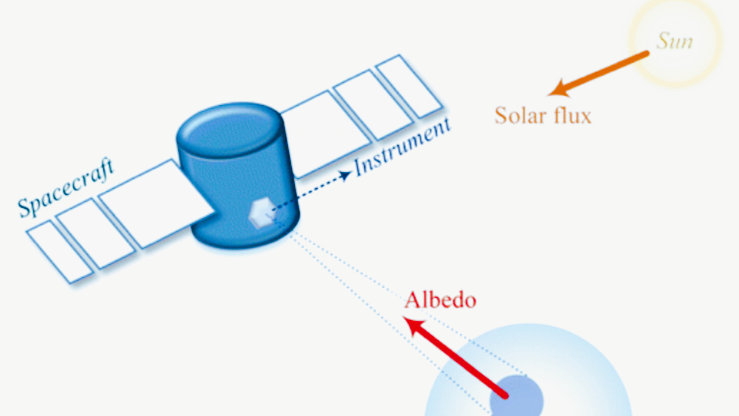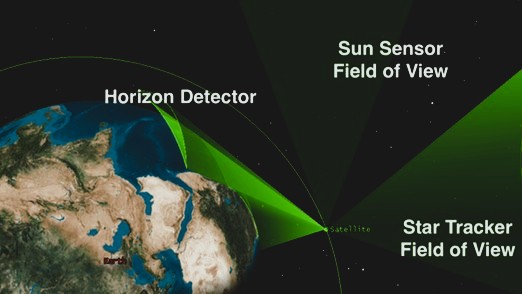
Sun sensors and star trackers serve as two of the most common attitude sensors in spacecraft, and they play vital roles in determining spacecraft orientation.
Engineers refer to the Sun Sensor (also known as a solar sensor or sun tracker) as a device that measures the incident angle of sunlight to determine the spacecraft’s direction relative to the Sun, thereby enabling attitude estimation. The sensor operates based on the photoelectric effect: it typically incorporates photosensitive elements such as photodiodes or CCDs (charge-coupled devices), which capture both the intensity and direction of sunlight.
Sun sensors offer significant advantages due to their simplicity and high reliability. They do not require complex star catalog matching algorithms and rely solely on the Sun as a reference source. In orbits where the Sun remains visible, these sensors deliver continuous attitude data. Moreover, they consume very low power—typically well under 1 watt—and remain lightweight, which makes them particularly suitable for resource-constrained microsatellites and CubeSats.
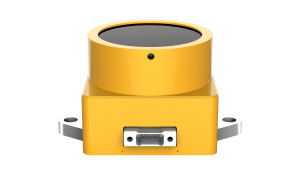
In contrast, the Star Sensor (also called a star tracker or stellar sensor) stands out as one of the highest-precision sensors in spacecraft attitude determination systems. It calculates the spacecraft’s three-dimensional attitude by observing the positions of stars. Operating much like an astronomical telescope, the star sensor houses a high-resolution CCD or CMOS camera that captures images of the star field. The system then matches these images against a pre-stored star catalog to identify known stars and compute the spacecraft’s precise orientation.
Star sensors excel primarily because of their exceptional accuracy. Modern star trackers achieve far higher precision than sun sensors—often in the range of arcseconds (e.g., around 0.0027° or better for high-end models)—which renders them indispensable for deep-space missions and precision scientific tasks.
Accuracy and Precision
Sun sensors generally provide accuracy ranging from about 0.1° to several degrees, which suits them well for coarse attitude control. Star sensors, however, deliver significantly superior precision and serve as the most accurate attitude determination component on spacecraft. Consequently, mission designers choose star sensors whenever applications demand high-resolution pointing.
Reliability and Environmental Adaptability
Sun sensors perform highly reliably in sunlit regions but lose functionality in Earth’s shadow, requiring a switch to alternative sensors. Star sensors prove more robust overall since they operate effectively at any time of day or night. Nevertheless, they remain sensitive to strong light interference, such as when operating near the Sun or other bright sources.
Cost and Resource Consumption
Sun sensors come at a low cost (often just a few thousand dollars), feature minimal power draw (typically Star sensors, while more expensive (often tens of thousands of dollars) and power-hungry (commonly 5–10 W), justify their higher resource demands in high-value missions where performance outweighs cost.
Typical Application Scenarios
– Sun Sensors find widespread use in low Earth orbit (LEO) satellites, sun-synchronous orbits, solar sail missions, and other scenarios where coarse sun-referenced pointing suffices or power/mass budgets remain tight.
– Star Sensors dominate in deep-space exploration, astronomical observatories, military reconnaissance satellites, and any mission that requires extremely precise attitude knowledge.
Send us a message,we will answer your email shortly!

TY-Space Technology (Beijing) Ltd. is professional focusing on advanced attitude optical sensors, especially Star Trackers for space industry.