
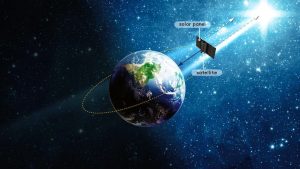
Sun sensor play a critical role in many spacecraft. However, if their environmental tolerance proves inadequate, rapid temperature changes, radiation damage, or severe vibration shocks can cause failure. Such failures frequently lead to total mission loss. These sensors are widely used on low Earth orbit (LEO) satellites, geostationary (GEO) communication satellites, planetary probes such as Mars explorers, and CubeSats.
Extreme Temperature Conditions
Orbital temperatures swing sharply from –150°C in shadow to +150°C under direct sunlight. In thermal vacuum, gradients become extremely steep. At low temperatures, silicon detectors often crack due to mismatched thermal expansion. At high temperatures, dark current rises sharply and sensitivity drops significantly.
Vacuum and Thermal Cycling
Vacuum causes material outgassing, which contaminates optical surfaces. Meanwhile, frequent thermal cycles—hundreds per day in LEO—generate mechanical stress relaxation and solder joint fatigue.
High-Energy Radiation
Space radiation delivers total ionizing dose (TID) and single event effects (SEE). Radiation degrades photodiode sensitivity, increases noise, and sometimes causes complete lock-up. Coarse analog sensors suffer particularly badly because radiation directly distorts their current output and ruins angle calculations.
Vibration, Shock, and Mechanical Stress
During launch, sensors endure 20 g sinusoidal vibration, 26.8 g random vibration, and 2000 g shock (3–10 kHz range). These intense forces can misalign optics, break bond wires, or deform structures.
Contamination, Optical Interference, and Micrometeoroids
Earth albedo, moonlight, or spacecraft-reflected light introduces measurement errors. Atomic oxygen erodes surface coatings. Micrometeoroids can even puncture thin protective windows.
– Operating temperature range: –25°C to +60°C (typical Leonardo S3 values)
– Storage temperature range: –40°C to +75°C
– Radiation tolerance: ≥36 krad(Si), with options reaching 100–300 krad or higher
– Vibration and shock: 20 g sinusoidal, 26.8 g rms random, 2000 g shock
– Field of view (FOV): 110°–128° × 128°, some models achieve full-sky coverage (4π sr)
– Lifetime: 5–10 years in LEO, over 15 years in GEO
Send us a message,we will answer your email shortly!

TY-Space Technology (Beijing) Ltd. is professional focusing on advanced attitude optical sensors, especially Star Trackers for space industry.