
Star Tracker and Optical Navigation represent two major optical navigation technologies. Each offers distinct features and ideal use cases.
Star Tracker
Star trackers serve as high-precision optical attitude sensors. They determine a spacecraft’s three-axis orientation (pitch, yaw, roll) in real time. Modern units employ CCD or CMOS sensors. Their field of view ranges from several degrees to tens of degrees. They track dozens to hundreds of stars simultaneously. This delivers sub-arcsecond accuracy (better than 0.001°).
Key Advantages:
– Star trackers deliver exceptional accuracy. They avoid drift over time, far outperforming conventional gyroscopes.
– They operate fully passively and autonomously. They require no ground support and resist electromagnetic interference strongly.
– They perform reliably in deep space. Most satellite ADCS systems rely on them as core sensors.
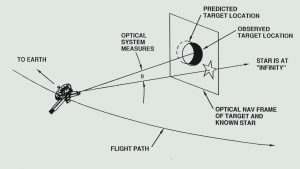
Unlike star trackers, which focus on attitude, optical navigation excels at determining absolute position, velocity, and orbit parameters. Onboard cameras capture images of target bodies (planets, moons, craters, asteroids). Image-processing algorithms extract key features (centroids, limb edges, landmarks). Then the system combines these with known celestial models to compute relative or absolute navigation data.
Core Strengths:
– Optical navigation achieves high autonomy. It suits deep-space missions perfectly because it eliminates reliance on ground tracking networks and reduces communication delay risks.
– It provides both attitude and position information simultaneously. One instrument serves multiple purposes.
– It reaches outstanding precision near celestial bodies. This enables safe, autonomous landings during planetary approaches or orbits.
– When fused with an IMU, it creates a robust closed-loop navigation system. This greatly enhances interference resistance.
Primary Role
Star trackers act as “attitude specialists.” They provide absolute pointing in the inertial frame.
Optical navigation functions as a “position expert.” It excels at relative celestial navigation.
Accuracy Levels
Star trackers achieve attitude precision of 0.1–1 arcsecond.
Optical navigation delivers meter-level position accuracy during close-range landing. At long-range cruise, it reaches kilometer-level precision.
Reliability and Environment Fit
Star trackers work almost continuously in deep space, where stars remain constantly visible. However, stray light disrupts them.
Optical navigation depends on specific targets. It uses bright planets as references in interplanetary space. It truly shines during landing phases near bodies.
Cost, Size, and Power
Star tracker hardware has matured significantly. Commercial models now offer excellent cost-performance.
Optical navigation systems require wide-field cameras and powerful processors. They demand higher initial investment. However, growing integration trends continue to narrow the gap between the two technologies.
Send us a message,we will answer your email shortly!

TY-Space Technology (Beijing) Ltd. is professional focusing on advanced attitude optical sensors, especially Star Trackers for space industry.