
In spacecraft attitude control systems, engineers widely use Star Trackers and Earth Sensor as the two most common attitude measurement devices. These sensors directly determine whether satellites can accurately point toward Earth, deep-space targets, or specific payloads. Their performance decides the success or failure of communication, remote sensing, and scientific exploration missions.
Star Tracker, also known as a star sensor or star tracker, offers the highest precision among spacecraft attitude measurement devices today. It treats stars as inertial reference sources. The device captures star images and matches them with its onboard star catalog database. Then it calculates the satellite’s three-axis attitude (roll, pitch, and yaw) in inertial space.
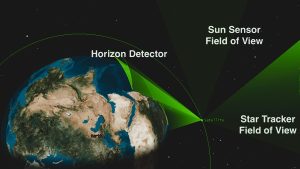
Earth Sensor, also called an Earth sensor or infrared horizon sensor, mainly helps determine the satellite’s nadir-pointing attitude relative to Earth. It detects infrared radiation from Earth’s atmosphere (typically in the 14-16μm CO₂ absorption band). By identifying the Earth’s horizon, the sensor computes the pitch and roll angles.
It achieves extremely high precision, reaching sub-arcsecond level. As the only single sensor that supplies full three-axis high-accuracy attitude, it is commonly used in closed-loop control systems.
It demonstrates strong autonomy. The device needs no external signals and shows excellent anti-interference capability against electromagnetic noise or solar flares.
It produces no accumulated errors. Unlike gyroscopes that suffer from drift, Star Trackers maintain stable performance over long periods.
It offers multiple functions. When combined with an IMU (Inertial Measurement Unit), it enables accurate attitude estimation even under high-dynamic conditions.
It features low cost and high reliability. With a simple structure and no need for complex star catalogs, it suits CubeSats and low-cost commercial satellites perfectly.
It consumes low power and has low mass. These traits save valuable satellite platform resources, especially for long-life missions.
It operates day and night. Infrared detection remains unaffected by Earth shadows, so it provides attitude data even during eclipses.
It optimizes Earth-pointing tasks. The sensor directly outputs the nadir vector, which simplifies the control loop. This makes it ideal for remote sensing and communication satellites.
Engineers apply these sensors in different real-world scenarios.
Star Trackers dominate high-precision missions. These include scientific satellites for astronomical observation, laser communication satellites, and deep-space probes.
Earth Sensors lead in cost-sensitive applications. They appear frequently in low-cost Earth observation satellites, meteorological satellites, and commercial communication constellations. CubeSats often use infrared Earth Sensors to achieve Earth-pointing stability. Their cost is only one-tenth that of Star Trackers.
Send us a message,we will answer your email shortly!

TY-Space Technology (Beijing) Ltd. is professional focusing on advanced attitude optical sensors, especially Star Trackers for space industry.