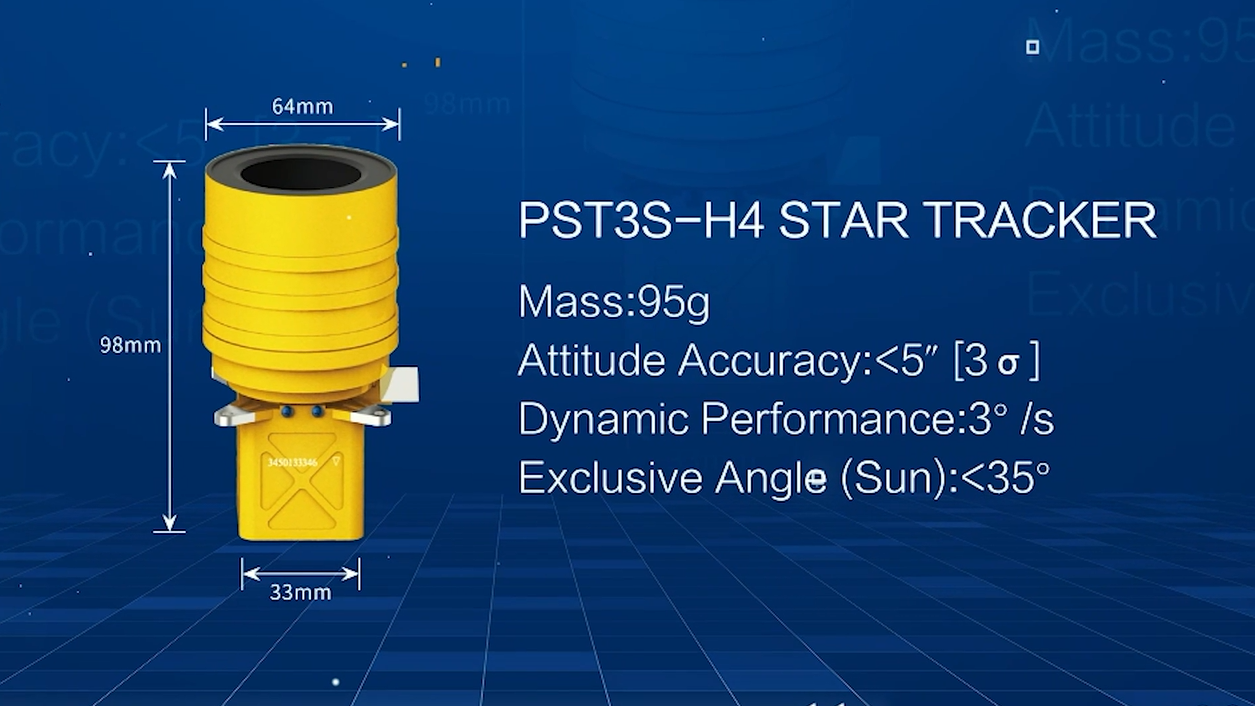
Star trackers ensure precise attitude determination and control. They serve as attitude trackers for spacecraft. These devices observe stars to determine the spacecraft’s orientation relative to the star field.
What Is Star Tracker Update Rate?
Star tracker update rate typically uses hertz (Hz) as its unit. It indicates the frequency at which the device provides updated attitude information to the satellite’s onboard computer. For example, a 5 Hz update rate means the star tracker outputs new orientation data five times per second.

Why Does Star Trackers Update Rate Matter?
Slight delays in attitude updates cause pointing accuracy errors. Therefore, higher update rates enable faster corrections. Consequently, they improve overall satellite control performance.
Factors That Affect Star Tracker Update Rate
Detector Technology and Shutter Mode: The type of image tracker—Charge-Coupled Device (CCD) or Complementary Metal-Oxide-Semiconductor (CMOS)—influences processing speed. Global shutter (GS) mode captures the entire image simultaneously. However, rolling shutter (RS) mode scans row by row. RS mode often achieves higher update rates because it overlaps exposure and readout phases.
Computational Power and Algorithms: Onboard processing determines the speed of star catalog identification and attitude calculation. Complex algorithms handle star centroid extraction, pattern matching, and error correction. These processes can reduce the update rate. However, improvements like adaptive thresholding or machine-learning-based pattern recognition restore performance and increase the rate.
Tracking Rate and Slew Rate: The satellite’s maximum angular slew rate affects update frequency. If the satellite rotates too quickly (for example, >2°/second), the star tracker may lose lock. As a result, the update rate drops.
Environmental Factors: Space radiation, temperature variations, and stray light degrade tracker performance. For instance, protons cause single-event upsets (SEU), which corrupt data. Engineers therefore use robust shielding and error-correction software.
5. Power and Size Constraints: Small satellites, such as CubeSats, face strict power limits. These constraints restrict processing speed. Low-power designs prioritize efficiency. Thus, they often limit the update rate to 4-5 Hz to conserve energy.
Send us a message,we will answer your email shortly!

TY-Space Technology (Beijing) Ltd. is professional focusing on advanced attitude optical sensors, especially Star Trackers for space industry.