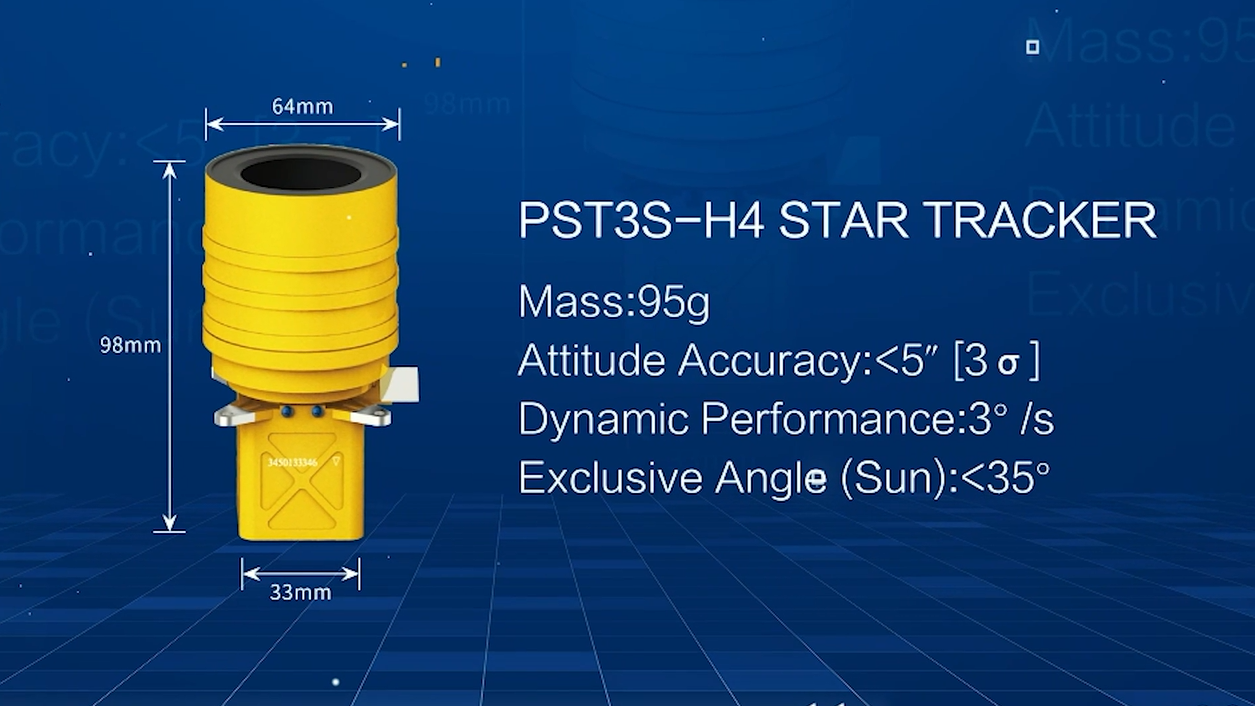

Star trackers serve as core components in satellite attitude control systems. Their technical specifications directly determine satellite stability and mission execution efficiency. Key specifications include static accuracy, dynamic performance, field of view, update rate, power consumption, and mass. These indicators reflect product maturity. They also influence satellite design costs and lifespan.
Star trackers act as critical parts of the Attitude Determination and Control Subsystem (ADCS). They provide high-precision absolute attitude references. Thus, they help satellites maintain correct orientation. Additionally, they prevent mission failures caused by deviations.

Accuracy stands as the most core technical indicator for star trackers. Engineers measure it in arcseconds (“). It divides into static accuracy and dynamic accuracy. Static accuracy refers to attitude measurement error when satellites remain stationary or move at low speeds. Dynamic accuracy, however, considers measurement capability during high-speed rotation or maneuvers.
The Field of View (FOV) describes the sky area that the optical system observes. Designers usually express it in degrees (°). A larger FOV helps capture more stars quickly. Therefore, it improves initial attitude acquisition probability. Yet, it increases optical distortion and computational complexity. Conversely, smaller FOV designs prioritize accuracy. Thus, they suit high-precision missions.
The sun exclusion angle represents an important FOV-related indicator. It defines the angular range where star trackers avoid direct sunlight.
The update rate determines the star tracker’s real-time response capability. A high update rate enables satellites to respond quickly to external disturbances. For example, it handles atmospheric drag or micrometeoroid impacts effectively.
Dynamic performance indicators quantify star tracker adaptability during satellite maneuvers. These include maximum angular velocity and angular acceleration.
Power consumption and mass matter significantly. Star trackers typically weigh 3-5 kg and consume 5-10 W. Lightweight designs emerge as a growing trend.
Send us a message,we will answer your email shortly!

TY-Space Technology (Beijing) Ltd. is professional focusing on advanced attitude optical sensors, especially Star Trackers for space industry.