
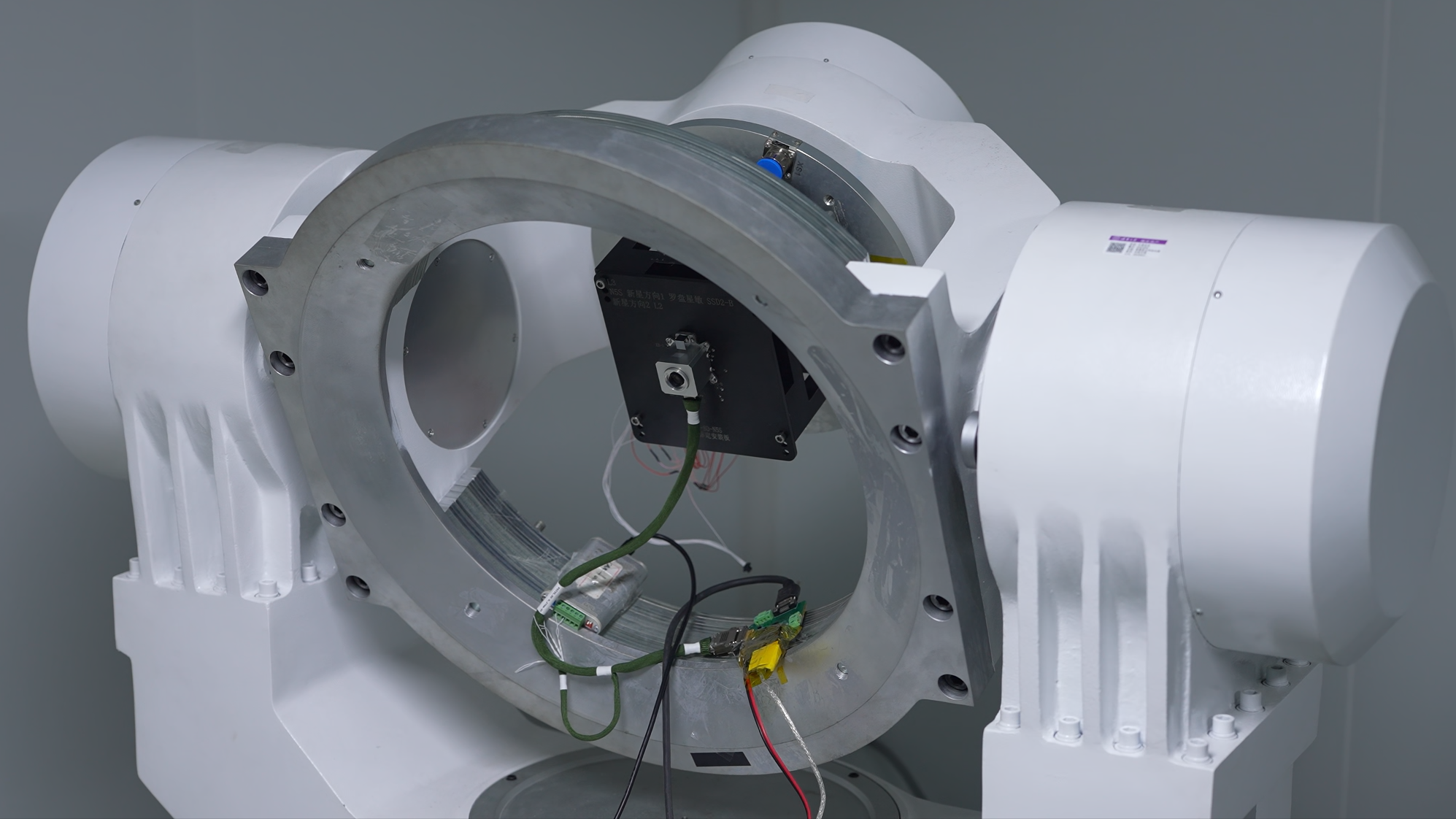
In aerospace and satellite technology, star trackers serve as a core device for high-precision attitude determination and navigation. Star trackers avoid drift issues and provide long-term absolute attitude references. They deliver the highest accuracy among all attitude sensors on spacecraft.
Key Performance Indicators of Star Tracker
Major specifications include accuracy, field of view, update rate, power consumption, mass, volume, and radiation tolerance.
Attitude Measurement Accuracy
Engineers measure accuracy in arcseconds (1″ ≈ 1/3600°). They specify single-axis accuracy and three-axis RMS accuracy (usually as 3σ values). Higher-accuracy star trackers support high-resolution Earth observation and precise deep-space pointing missions.
Field of View (FOV)
The field of view directly affects initial acquisition speed (Lost-in-Space) and the number of available stars.
– Standard FOV: 15°×15° to 25°×25° (circular or square)
– Wide-FOV models: exceed 30°
– Small-satellite versions: typically 18°–20°, balancing acquisition speed and accuracy
Larger fields of view shorten initial attitude acquisition time, yet they may slightly reduce accuracy.
Update Rate and Maximum Slew Rate
Agile imaging satellites demand high update rates and high angular slew rates.
Power Consumption, Mass, and Volume (SWaP)
CubeSats and nanosatellites remain extremely sensitive to power and mass. Therefore, low-SWaP products enjoy strong market demand.
Radiation Tolerance and Environmental Robustness
Star trackers withstand random vibration (above 14.16 g RMS), thermal cycling (−40°C to +70°C), and other launch and on-orbit conditions.
How to Select a Star Tracker for Your Mission?
Accuracy Requirement: Scientific imaging needs
Power and Mass Budget: 1U–3U CubeSats prioritize products under 350 mW and 100 g.
Orbit Environment: GEO missions choose high-radiation, long-life models; LEO missions allow relaxed requirements.
Maneuverability: Agile satellites require ≥2°/s slew rate.
Cost and Lead Time: COTS products deliver quickly; custom models need longer cycles.
Interfaces and Software: Mainstream options support RS422/RS485 and SpaceWire; some directly output quaternions.
Send us a message,we will answer your email shortly!

TY-Space Technology (Beijing) Ltd. is professional focusing on advanced attitude optical sensors, especially Star Trackers for space industry.