Star tracker serve as the core sensors for attitude determination. Their main challenge comes from intense interference by bright celestial bodies, especially solar glare.
When strong light from the sun, Earth, or moon enters the field of view, the sensor becomes severely “blinded.” This causes star identification to fail, attitude output to drop, and sometimes even triggers full spacecraft attitude loss. Therefore, solar exclusion capability ranks among the most critical performance metrics for star trackers.
Space is far from completely dark; instead, it contains extremely bright sources. The sun, as the brightest radiator, outshines any visible star by orders of magnitude. Whenever spacecraft attitude positions the sun inside—or near—the star tracker’s field of view (FOV), direct or scattered light quickly saturates the image sensor and completely drowns out faint star signals.
Different orbits face markedly different levels of solar interference:
– Low Earth Orbit (LEO): Earth albedo is very high, so sun, Earth, and moon appear frequently in quick succession.
– Sun-Synchronous Orbit (SSO): Maintains a nearly fixed sun angle for long periods, yet still demands strict exclusion.
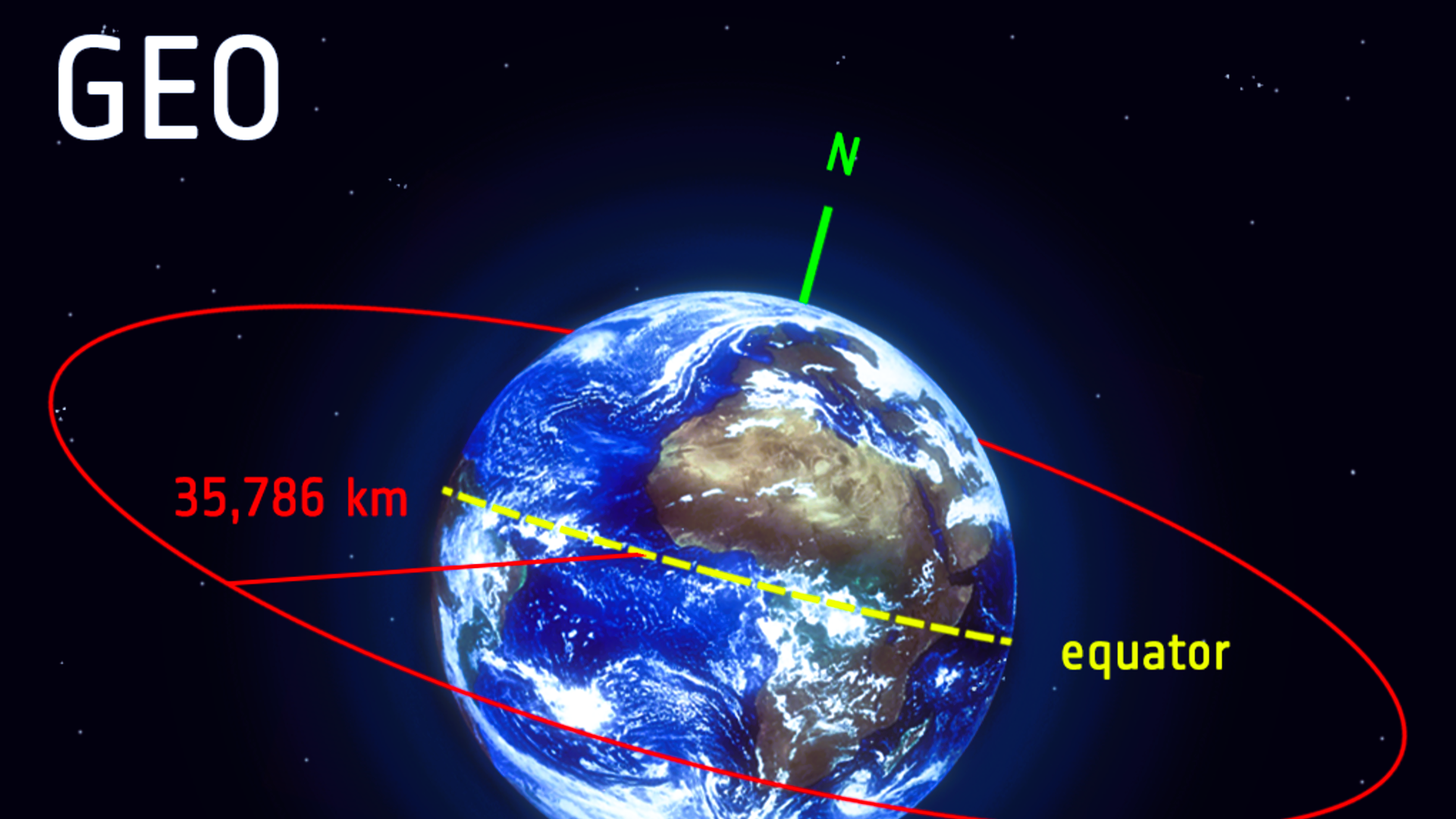
– Geostationary Orbit (GEO): Remains exposed to sunlight for extended durations, requiring excellent stray-light rejection.
– Deep-space missions: Encounter complex stray-light sources such as sun backlighting, planetary reflections, and engine plumes.
Core Implementation Methods for Solar Exclusion in Star Trackers
Optical Baffle Design
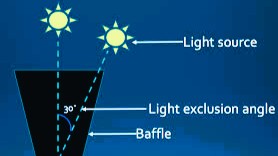
Baffles represent the primary hardware solution for solar exclusion. Common baffle types include:
– Multi-stage conical baffles: Use successive vanes to block and absorb stray light step by step.
– Knife-edge apertures: Place extremely thin knife edges at critical locations to minimize diffraction.
– Deployable/retractable baffles: Fold compactly during launch, then extend on orbit to balance launch envelope and in-flight performance.
High-quality baffles feature ultra-black coatings on inner surfaces, achieving reflectivity below 0.5%—sometimes even below 0.1%. Typical performance figures are:
– Solar exclusion half-cone angle: 25°–40°
– Stray-light suppression ratio: 10⁻⁶ to 10⁻⁸ outside the exclusion angle
– Earth albedo exclusion angle: usually 15°–25°
Software and Algorithm-Based Exclusion
Modern star trackers rely heavily on intelligent algorithms to boost interference resistance:
– Bright-object detection and rejection: The system instantly identifies unusually bright targets in the field and masks them.
– Adaptive thresholds and dynamic windows: The algorithm automatically adjusts recognition parameters according to background brightness.
– Star-map prediction and fault-tolerant matching: After brief outages, the tracker rapidly reacquires stars.
– Event-based imaging: This emerging technique dramatically reduces the impact of strong light (still under development).
Structural and Installation Optimization
Several design choices further enhance exclusion performance:
– Separated optical-electronic module architecture: This approach minimizes thermal distortion effects on the optical axis.
– Multi-star-tracker networked layout: Engineers arrange mounting angles to achieve complementary coverage, preventing the sun from entering all fields simultaneously.
– Attitude planning and maneuver constraints: During on-orbit operations, mission planners deliberately avoid placing the sun inside critical exclusion zones.
Send us a message,we will answer your email shortly!

TY-Space Technology (Beijing) Ltd. is professional focusing on advanced attitude optical sensors, especially Star Trackers for space industry.