
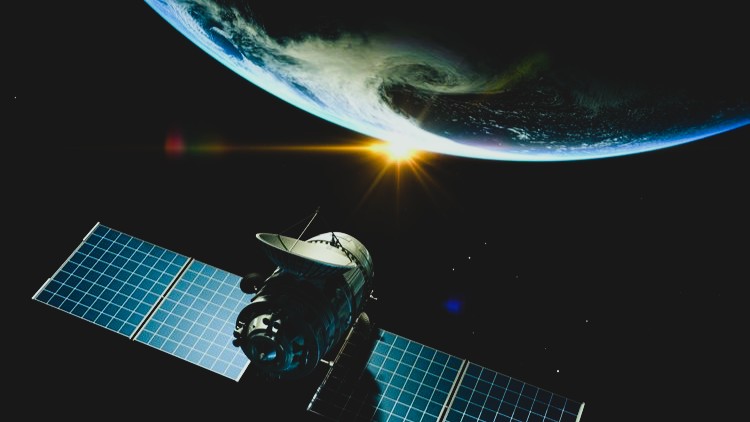
Satellites and spacecraft must navigate precisely in extremely harsh space environments. As the core device for attitude determination, the star tracker faces strong cosmic radiation in space. Radiation resistance of star trackers is a critical factor that determines mission success.
The main components of the space radiation environment include:
– Galactic Cosmic Rays (GCR): high-energy particles from distant supernovae with extremely strong penetration.
– Solar Particle Events (SPE): large fluxes of high-energy protons released during solar flares.
– Van Allen Radiation Belts: high-energy electrons and protons trapped by Earth’s magnetic field.
Without sufficient radiation resistance, star trackers may lose star points, produce attitude errors, or even fail completely. This risk becomes especially severe for GEO satellites with 15+ year lifespans, Jupiter missions, or Mars missions, where total radiation doses can reach tens to hundreds of krad(Si).
Radiation effects mainly appear as follows:
– Image noise increases significantly, weakening detection of faint stars (magnitude 6–7.5).
– Centroid positioning accuracy of star points deteriorates.
– Electronic components experience transient or permanent failures.
– Optical coatings and glass materials darken, reducing transmittance.
Core technologies in modern star tracker radiation-hardened design
Engineers replace traditional CCDs with radiation-hardened CMOS active pixel sensors (APS), which offer much better resistance to both ionization and displacement damage.
Designers use high-density materials such as tantalum and aluminum to create effective shielding layers. They also adopt separated optical head and processing unit architectures to improve thermal stability and radiation protection.
Key protective measures include real-time SEU detection and correction, watchdog resets, program redundancy comparison, and fast recovery algorithms after radiation events (such as star pattern re-identification and enhanced noise filtering).
Manufacturers apply radiation-resistant quartz glass and advanced coating technologies to maintain high transmittance while withstanding solar ultraviolet and particle bombardment.
For CubeSats and micro-satellites, engineers carefully balance size, weight, power consumption (SWaP) with required radiation hardness.
Send us a message,we will answer your email shortly!

TY-Space Technology (Beijing) Ltd. is professional focusing on advanced attitude optical sensors, especially Star Trackers for space industry.