
Star trackers have become an indispensable core sensor in modern spacecraft Attitude Determination and Control Systems (ADCS), playing a critical role in satellites, deep-space probes, and CubeSats.
The ADCS serves as the spacecraft’s “navigation brain.” It determines and controls the vehicle’s spatial attitude (i.e., its orientation relative to the inertial reference frame) in real time. Whether for Earth observation satellites, communication satellites, or planetary explorers, precise attitude management remains essential.
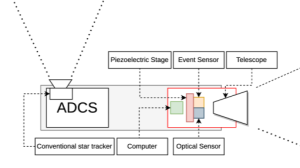
The ADCS typically consists of three main modules: attitude sensing, attitude estimation, and attitude control. Attitude sensing relies on various sensors to collect external reference signals. Attitude estimation fuses these measurements using filtering algorithms (such as the Kalman filter) and outputs the attitude in the form of quaternions or Euler angles. Attitude control then drives actuators—such as reaction wheels, magnetic torquers, or thrusters—to generate control torques and achieve the desired orientation adjustment.
Within the ADCS, star trackers primarily perform absolute attitude determination. They provide a high-accuracy reference that corrects gyroscope drift and enables true closed-loop control. Configurations with multiple star trackers further enhance redundancy: by fusing data from several units, the system compensates for blind zones of individual units (e.g., Sun interference or exclusion regions).
– Extremely high accuracy: typically 3–10 arcseconds, far surpassing sun sensors (~0.1°) or magnetometers, making them ideal for science-grade missions.
– Full autonomy: they require no ground-uploaded initial attitude and support fast Lost-in-Space acquisition and recovery.
– Independent reliability: unaffected by Earth’s magnetic field or Sun position, with sky coverage exceeding 99%.
– Low power and compact size: well suited to micro- and nano-satellites, helping reduce overall ADCS cost and mass.
At their core, star trackers combine optical precision with intelligent image-processing algorithms, effectively providing spacecraft with “eyes” capable of highly accurate attitude perception.
Send us a message,we will answer your email shortly!

TY-Space Technology (Beijing) Ltd. is professional focusing on advanced attitude optical sensors, especially Star Trackers for space industry.