Star tracker serve as high-precision optical attitude determination systems. They capture images of surrounding stars and compare them with an onboard star catalog. This process calculates the spacecraft’s three-axis attitude (pitch, yaw, roll) in real time.
Unlike near-Earth orbits, which can still partially rely on GPS or ground tracking, deep-space missions travel hundreds of millions or even billions of kilometers from Earth. Here, star trackers become the only reliable, long-term autonomous attitude determination solution.

Their accuracy typically reaches arcsecond level (or even sub-arcsecond level). This means that even at hundreds of millions of kilometers, attitude errors translate into extremely small pointing deviations. Such precision enables several critical functions:
Solar arrays maintain accurate Sun-pointing for sufficient power generation.
High-gain antennas achieve precise Earth communication.
Scientific payloads (such as cameras and spectrometers) accurately align with target celestial bodies.
The spacecraft performs autonomous orbit corrections and deep-space maneuvers.
Modern deep-space star tracker commonly feature radiation hardening, stray-light suppression, and low power consumption. They operate stably under extreme temperature variations, intense radiation, and prolonged periods without ground intervention.
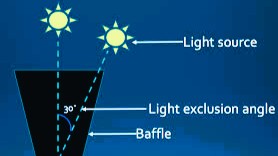
In strong radiation environments, cosmic rays and solar proton events can cause single-event upsets (SEU) or single-event latch-up (SEL). To counter stray-light interference from the Sun, planets, Moon, or engine plumes, designers widely adopt long baffles, multi-stage apertures, dynamic thresholds, and adaptive windows.
Long-term on-orbit thermal deformation and installation errors remain major challenges. Thermal distortion often causes optical axis drift, especially in later mission phases. Current mainstream solutions include on-orbit thermal model compensation, cross-calibration between multiple star trackers, and real-time estimation based on Kalman filtering.
For small satellites and deep-space CubeSats, low power consumption and miniaturization are essential. Power typically stays below 5–10 W, while mass remains under 1 kg.
AI-powered star pattern recognition
Multi-tracker fusion navigation
Quantum optics and cold atom technologies
Ultra-miniaturization and swarm applications
Send us a message,we will answer your email shortly!

TY-Space Technology (Beijing) Ltd. is professional focusing on advanced attitude optical sensors, especially Star Trackers for space industry.