
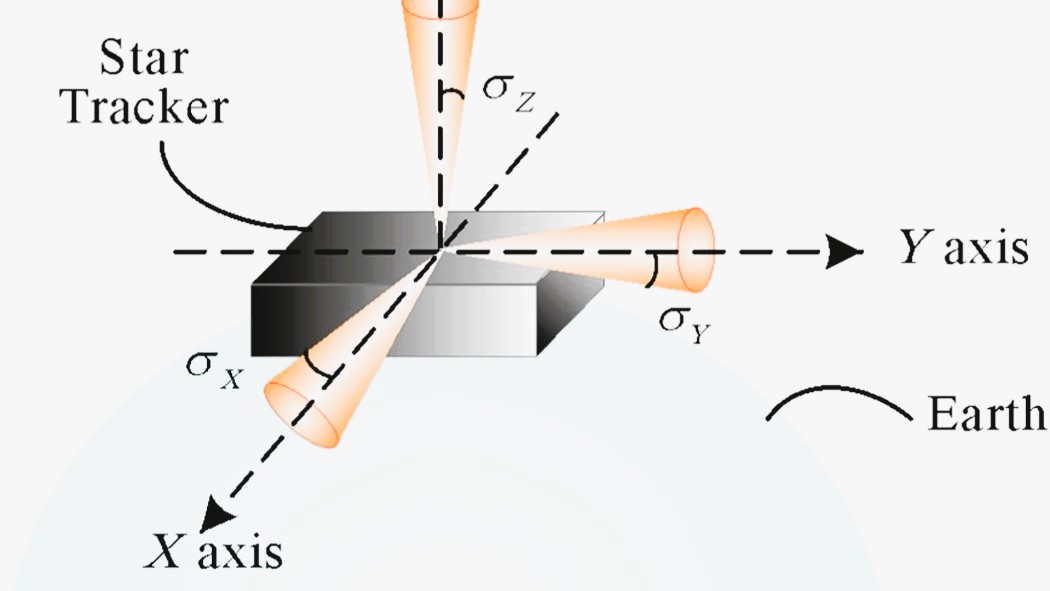
Errors in star trackers can cause attitude misalignment, reduce task efficiency, and even lead to mission failure in extreme cases. Common error sources include random errors, systematic errors, and environment-induced errors. These arise from multiple factors such as optics, electronics, and the space environment.
Low-Frequency Errors (LFE)
Low-frequency errors rank among the most common in star trackers. They mainly result from thermal variations in space. As satellites orbit, they experience alternating sunlight exposure. This causes temperature fluctuations that induce thermo-elastic deformation in the sensor structure. The deformation slowly shifts optical alignment and produces gradual drift in star position measurements.
Systematic Errors
Systematic errors create predictable and consistent biases. They often stem from inherent design flaws or calibration issues. In many modern star trackers, systematic errors dominate the overall attitude error budget.
Bias errors: Fixed offsets in measurements, frequently caused by manufacturing tolerances or sensor aging.
Optical aberrations: Spherical aberration, chromatic aberration, and similar effects in the lens system blur star images and shift centroids.
Defocus errors: Misalignment of the focal plane defocuses star images and worsens under-sampling on the detector array.
Random Errors and Noise
Random errors appear as unpredictable fluctuations and typically manifest as system noise. Main contributors include:
Temporal noise: Electronic noise from the detector, readout circuits, shot noise, read noise, and dark current.
High spatial frequency (HSF) errors: Rapid variations across the field of view, often due to pixel-to-pixel differences or stray light interference.
Under-sampling effects: When the detector pixel grid fails to fully capture the star’s point spread function, aliasing occurs and position accuracy suffers.
Environmental and External Error Sources
The harsh space environment introduces additional errors to the sensor itself:
Stray light and background interference: Bright light from the Sun, Moon, or Earth pollutes the star field, causing false detections or centroid shifts.
Radiation effects: Cosmic rays and solar particles damage detectors, raise noise levels, or trigger transient faults.
Vibration and mechanical disturbances: Satellite maneuvers or thruster firings generate vibrations that blur images.
Ephemeris error propagation: In navigation systems that use satellite ephemeris data, inaccurate orbit predictions directly transfer into attitude errors.
How to Reduce Star Tracker Errors
Perform advanced calibration using ground simulations and on-orbit data to model errors accurately.
Apply error compensation algorithms such as neural networks or polynomial fitting to identify and correct low-frequency errors.
Optimize hardware by using radiation-hardened detectors and adding baffles or shades to block stray light.
Fuse data from multiple sensors by combining star tracker measurements with gyroscopes or IMUs to improve overall accuracy.
Send us a message,we will answer your email shortly!

TY-Space Technology (Beijing) Ltd. is professional focusing on advanced attitude optical sensors, especially Star Trackers for space industry.