
Star tracker calibration is the key to ensuring long-term high accuracy. Without validation or timely calibration, a star tracker’s attitude output error can rapidly degrade from a few arcseconds to tens of arcseconds or even worse. This directly affects the success of high-precision Earth observation, deep space exploration, and laser communication missions.
The main error sources that influence accuracy include:
– Optical system errors (focal length, principal point shift, radial/tangential distortion)
– Installation errors (misalignment between the optical axis and the spacecraft body coordinate system)
– Environmental factors (thermal drift caused by temperature changes, pixel response drift due to space radiation)
– Dynamic errors (spacecraft jitter, smearing, etc.)
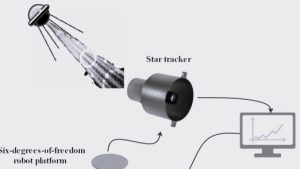
Ground calibration is usually performed in clean laboratories or observatories. The main goal is to establish a high-precision initial parameter model while simulating space conditions as closely as possible.
Traditional Optical Laboratory Calibration
Engineers use laser collimators, collimators, precision turntables, and other equipment to calibrate the geometric parameters of the star tracker. This method achieves high accuracy, but the equipment is expensive and the process takes a long time. It suits high-performance large satellites.
Low-cost Ground Calibration Based on Earth Rotation
This highly innovative and economical method fixes the star tracker on a stable platform and uses Earth’s rotation (approximately 15 arcseconds per second) as a natural high-precision turntable. Engineers take long-exposure star trail images and then estimate focal length, distortion parameters, and principal point offset from the apparent motion speed of the stars.
Real Sky Astronomical Calibration
This approach calibrates the star tracker using the actual night sky. Technicians point the tracker toward the near-zenith area, combine high-precision clocks with astronomical star catalogs, and optimize all camera intrinsic parameters through multiple observation datasets.
In-orbit Calibration Technology
After the spacecraft enters orbit, ground intervention becomes impossible. Therefore, the star tracker must possess certain autonomous calibration capabilities to cope with long-term drifts caused by thermal deformation, radiation damage, and other factors.
Send us a message,we will answer your email shortly!

TY-Space Technology (Beijing) Ltd. is professional focusing on advanced attitude optical sensors, especially Star Trackers for space industry.