
The star tracker baffle blocks stray light mechanically and absorbs it effectively. This attenuation ensures the optical system receives only starlight within the field of view. The star tracker captures star images inside its field of view. It compares them with the built-in star catalog and outputs the satellite’s three-axis attitude angles. In space, intense sources like the Sun, Earth albedo, and Moon create severe stray light. This stray light saturates the detector, blurs star spots, or sharply reduces signal-to-noise ratio. As a result, it directly degrades attitude determination accuracy.
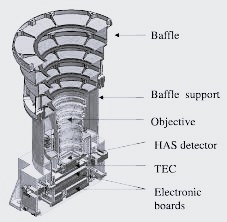
No direct line-of-sight
The optical elements (lens or detector) must never directly see illuminated baffle inner walls or vane knife-edges.
Multi-stage reflection attenuation
Stray light undergoes multiple reflections inside the baffle. Each bounce increases path length and maximizes absorption.
Minimal size and weight
Designers balance a large solar exclusion angle (typically 30°–45°) with the required field-of-view angle (usually 10°–50°).
Optical performance of the star tracker baffle depends heavily on inner surface coatings. Engineers must apply high-absorptivity blackbody materials to all inner walls and vanes.
Modern star tracker baffle design relies on professional optical simulation software. The typical process includes these steps:
Engineers model the baffle geometry (including taper and vanes) in SolidWorks or CATIA.
They import BRDF data into TracePro, Zemax OpticStudio, or FRED and run Monte Carlo ray tracing.
The software outputs the PST curve (logarithmic scale) and shows detector irradiance at various incident angles (0°–90°).
Designers iterate: they adjust vane number, height, and cone angle until PST falls below the threshold while keeping length and mass minimal.
Limitations of star tracker baffles
– CubeSats and small satellites face strict volume-performance trade-offs.
– Extreme orbits (GEO high heat or deep-space low temperature) cause thermal distortion and coating degradation.
– Multiple-sensor arrays suffer mutual stray-light interference.
Future trends
AI-assisted optimization
Machine learning automatically iterates vane parameters and taper angles.
Ultra-black coatings + nanostructures
New surfaces achieve BRDF very close to an ideal blackbody.
Integrated smart baffles
Embedded photoelectric sensors monitor stray light in real time and guide attitude adjustments.
Modular design
The architecture supports rapid customization for different exclusion angles and FOVs across star tracker product families.
Send us a message,we will answer your email shortly!

TY-Space Technology (Beijing) Ltd. is professional focusing on advanced attitude optical sensors, especially Star Trackers for space industry.