
Star sensor ground testing is a critical verification step. It ensures reliable device performance and meets mission requirements.
Space environments introduce microgravity, thermal vacuum, radiation, and micro-vibrations. These factors can all affect sensor performance. Therefore, comprehensive ground testing must occur before launch. It verifies full functionality, accuracy, and environmental adaptability. This approach prevents on-orbit failures and mission loss.
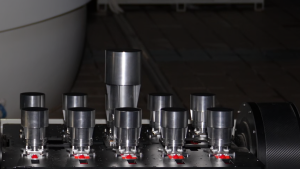
Ground testing addresses three key aspects:
Function verification Engineers confirm that the sensor correctly identifies star patterns and outputs valid attitude data.
Accuracy calibration They calibrate internal parameters such as focal length, distortion, principal point offset, and optical axis direction. This process eliminates manufacturing and installation errors.
Environmental adaptability testing Tests simulate space conditions including thermal vacuum, dynamic rotation, and strong light interference. They verify thermal stability, dynamic tracking capability, and anti-interference performance.
Main Components of the Ground Test System
Star simulator This core device generates high-fidelity simulated star fields. It includes controllable light sources (simulating stars of different magnitudes), precision mask plates (for star positions), and a collimating optical system (producing parallel rays to mimic infinity). High-precision static simulators achieve star position errors below 1 arcsecond, with magnitude adjustable from -2 to +6.
Multi-axis rate turntable It simulates spacecraft attitude maneuvers and orbital motion. The turntable provides angular rates of 0–10°/s with accuracy reaching 0.001°.
Dark room and thermal vacuum chamber These eliminate stray light and replicate space thermal conditions (-50°C to +80°C). Some chambers also support vacuum.
Alignment equipment Theodolites and laser trackers enable precise installation and alignment.
Data acquisition and control system Industrial computers and dedicated software (via Ethernet, RS422, etc.) collect quaternion, star coordinates, and other data in real time. They also perform statistical analysis.
Star sensor ground testing includes four main categories: static testing, dynamic testing, calibration testing, and environmental adaptability testing.
Engineers align the sensor Z-axis to true north and Y-axis to zenith using a theodolite.
After power-on, the system reads inertial-frame quaternions.
It converts them to Euler angles in WGS84 coordinates using local time and GPS position.
The roll angle is compared with local longitude, and yaw with local latitude.
Engineers record differences over 30 minutes and analyze X/Y-axis accuracy.
They rotate the setup 90° and repeat the test to verify Z-axis polarity and pitch accuracy.
Star points form streaks on the focal plane during motion.
This streaking disperses light intensity and reduces signal-to-noise ratio.
Tests show that typical star sensors maintain over 80% availability at 1°/s.
However, availability drops sharply below 30% above 2°/s.
Laboratory setups use fiber-coupled halogen lamps to simulate starlight.
Detection logic evaluates availability based on minimum pixel intensity, consecutive pixel count, and integration intensity thresholds.
Internal parameter calibration Engineers determine focal length, principal point, and distortion coefficients. They collect multiple images with a multi-star static simulator and solve parameters using least-squares methods.
Optical axis pointing calibration The turntable rotates to different angles. Engineers compare output attitude with actual rotation angles.
Thermal drift calibration Temperature changes occur inside the thermal vacuum chamber. Engineers measure optical axis drift (typically required
Thermal stability testing Engineers simulate orbital thermal cycles and verify thermo-elastic bias stability.
Stray light testing Tests replicate Earth albedo and direct sunlight to evaluate suppression performance.
Vibration and shock testing These simulate launch environments and confirm structural/functional integrity.
Send us a message,we will answer your email shortly!

TY-Space Technology (Beijing) Ltd. is professional focusing on advanced attitude optical sensors, especially Star Trackers for space industry.