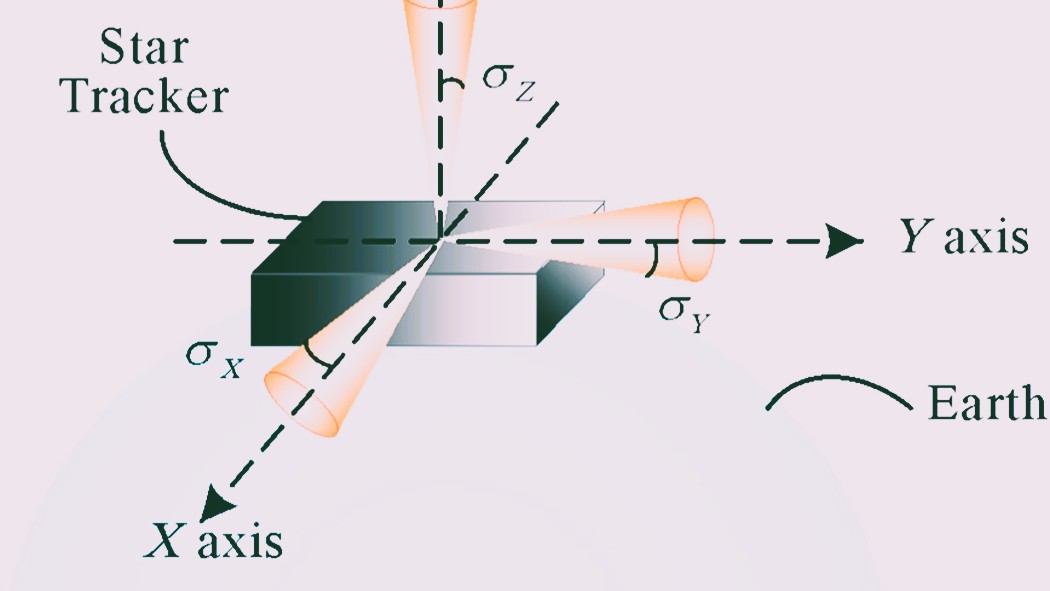
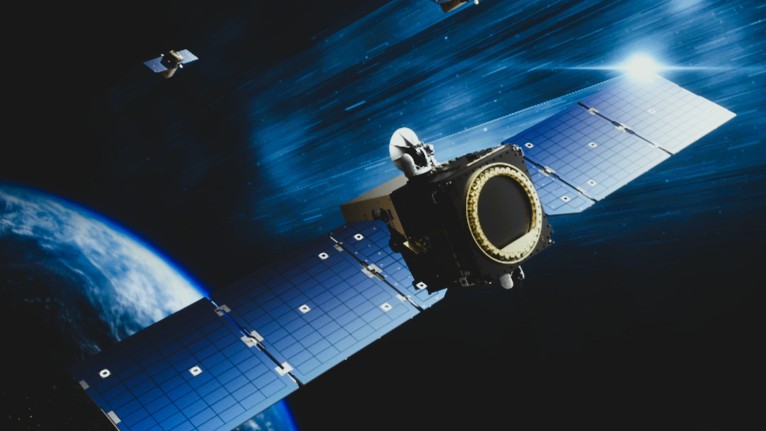
High-precision spacecraft star trackers essentially function as optical sensors. They observe stars to determine the spacecraft’s attitude (that is, its pointing direction). Furthermore, modern high-precision star trackers integrate digital imaging and advanced algorithms, and thus they achieve exceptional accuracy.
Star trackers typically operate in “staring” mode. In this mode, they focus on a small region of the sky and track a few stars with extremely high precision. Moreover, they employ CMOS or CCD imaging sensors to capture intentionally defocused star images. Then, they calculate the centroid of the light distribution, and this process enables sub-pixel level accuracy.

Key Components of High-Precision Star Trackers
– Optical System: The lens focuses starlight while blocking unwanted wavelengths to prevent sensor overheating.
– Detector: It converts photons into electrical signals; CCD detectors offer high sensitivity but remain vulnerable to radiation effects, whereas CMOS detectors prove more durable.
– Stray Light Baffle: It uses a shade or conical hood to prevent interference from the Sun, Earth, or Moon, and therefore it ensures normal operation outside exclusion zones.
– Electronics and Software: These components amplify signals, run matching algorithms, and interface with the spacecraft control system.
The Role of Accuracy in Spacecraft Navigation
In space environments, even tiny attitude errors can lead to mission failure. For instance, a satellite attitude deviation of just a few arcseconds might cause it to miss critical Earth imagery or disrupt communication links. High-precision models achieve cross-axis accuracy as low as 2-3 arcseconds (3σ), and this ensures reliability in demanding scenarios.
Additionally, high-precision spacecraft star trackers find wide application in various missions, ranging from commercial satellites to interplanetary probes. In the Earth observation field, they ensure that satellites in programs such as the Copernicus initiative maintain precise alignment. Consequently, they enable high-resolution imaging of climate patterns, disaster areas, or agricultural fields.
Send us a message,we will answer your email shortly!

TY-Space Technology (Beijing) Ltd. is professional focusing on advanced attitude optical sensors, especially Star Trackers for space industry.