
The price of satellite star trackers is influenced by their model, performance, and target market. Here are some key pricing details:
Commercial Star Trackers: Manufacturers typically price traditional commercial star trackers at around $30,000, designing them for large satellites or missions in high-radiation environments.
Small Satellite Star Trackers: Models designed for CubeSats and NanoSats have a broader price range, typically between $10,000 and $100,000. Basic models are less expensive, while high-precision or radiation-hardened models are pricier.
Low-Cost Innovations: The CubeSat Laboratory at Caltech is developing a star tracker with hardware costs below $250, aimed at providing an affordable solution for small satellite missions. This low-cost design leverages commercial off-the-shelf (COTS) components, significantly reducing costs while maintaining high performance.
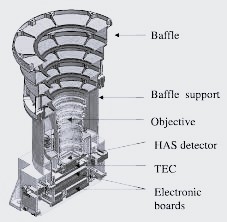
The price of star trackers is influenced by the following factors:
Accuracy: High-precision models (e.g., arc-second level) require more complex algorithms and optical systems, resulting in higher costs.
Size and Weight: Miniaturized designs, often tailored for small satellites, may be less expensive.
Mission Requirements: Features like high radiation tolerance, long lifespan, or specific orbits (e.g., GEO) increase costs.
Manufacturer and Brand: Well-known manufacturers such as Sodern, Terma, ty-space, and Rocket Lab may command higher prices due to brand reputation and technological advantages.
Production Scale: Models produced in large quantities (e.g., Sodern’s Auriga™, with 120 units per month) can reduce costs through economies of scale.
Star trackers play a critical role in various space missions, including:
Earth Observation Satellites: Ensuring precise pointing of cameras and sensors at target areas on Earth for remote sensing, weather monitoring, etc.
Communication Satellites: Maintaining accurate alignment of antennas with ground stations to ensure stable signal transmission.
Scientific Satellites: Providing high-precision pointing for astronomical observations or other scientific experiments, such as studying cosmic background radiation or planetary atmospheres.
Navigation Satellites: Offering stable attitude references for GPS and other navigation systems.
Small Satellites (CubeSats and NanoSats): As small satellite technology grows, star trackers are being miniaturized to fit smaller platforms, widely used in educational, research, and commercial missions.
Miniaturization: Developing smaller, lighter, and more energy-efficient star trackers to meet the needs of CubeSats and NanoSats.
Cost Reduction: Lowering prices through standardized components and innovative designs, such as COTS components.
Enhanced Functionality: Integrating features like debris monitoring and improved radiation tolerance to increase mission success rates.
Standardization: Promoting standardized interfaces and components to reduce integration costs and time for satellite manufacturers.
Send us a message,we will answer your email shortly!

TY-Space Technology (Beijing) Ltd. is professional focusing on advanced attitude optical sensors, especially Star Trackers for space industry.